
Controlled heat treatment: measurement and traceability
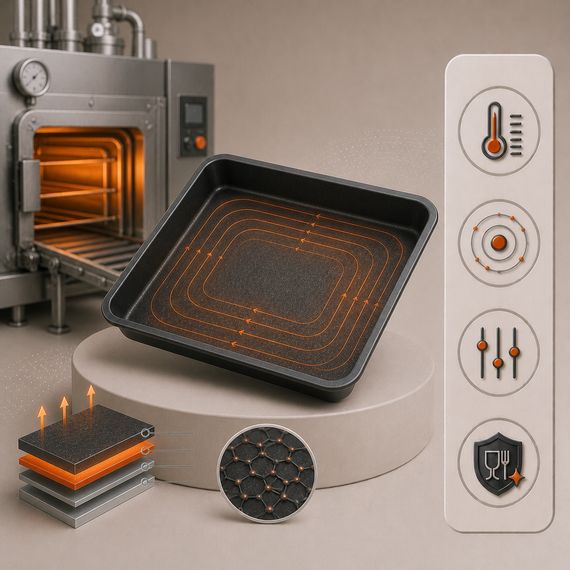
Controlled heat treatment is the traceable application of temperature and time conditions defined for a coating. A programmable oven alone does not prove that all parts have received the same treatment. Include the actual load, measurement points, and acceptance conditions in the process plan.
If a record contains an out-of-target value, simply running the program again may not be enough. Assess the part’s earlier thermal history and the selected material’s suitability for reprocessing separately; add the decision to the batch record.
The recipe and the actual process
Programmed heating and holding values describe the target; recorded temperatures show what actually occurred during processing. Compare these two records. The temperature reached by the part may differ from the oven air temperature. If load quantity or arrangement changes, the earlier assessment should not automatically be considered sufficient.
Coating formulations require different treatments. It is not appropriate to use the same temperature range or tolerance for every system. Curing involves reactions in some materials and film formation and sintering in others; a common cross-linking recipe should not be given for all polymers.
Measurement and traceability
| Control area | Required explanation |
|---|---|
| Recipe | Product code and approved processing conditions |
| Measurement | Sensor method and the area represented |
| Load | Part type, quantity, and arrangement |
| Deviation | Out-of-target condition and assessment decision |
The suitability of measuring instruments and their relationship to a reference are also part of recordkeeping. A digital display or a large number of sensors does not, by itself, show that a measurement is accurate. Linking the data archive to the relevant batch makes it possible to understand which treatment was performed during a post-delivery review.
The limits of automation
Tools such as a PLC, operator display, or centralized data collection may be used in a control plan. Their presence, however, does not establish uniform temperature, error-free production, or energy savings. Each claim must be supported by the relevant measurements and operating records. An alarm being triggered and a product being found acceptable are also different decisions.
Assessing a single batch in a batch oven and assessing parts processed on a continuous line may require different arrangements. Keeping the same recipe name is not sufficient without checking the effect of a line-speed or arrangement change on the part. Note any need for reassessment in the change record.
Share the body material, part geometry, and coating system when discussing the project with Powerpan. Clarify the heat treatment monitoring method, record scope, and final inspection requirements. Production temperature is not an end-use or food contact limit; this information is assessed separately in the product file.