
Oven curing of coatings: thermal history and inspection
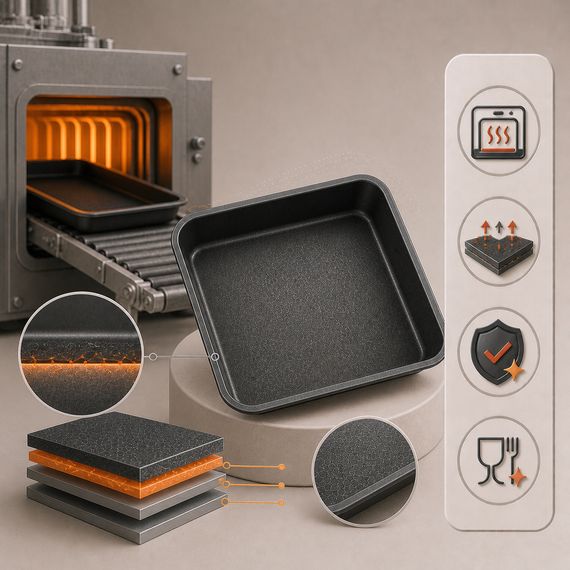
Oven curing is the heat treatment of an applied coating according to the selected system’s requirements. A successful process cannot be verified by looking only at the oven temperature display. Part heating, time spent at the target condition, and subsequent cooling must be assessed together.
The starting point for the duration recorded in the process log must be clear. Time elapsed since oven entry and time elapsed after the part reaches the target condition are not the same data. State which definition is used in a comparison. Without sensor location, load quantity, and part information, two temperature charts do not prove equivalent processing. If a deviation occurs, the delivery decision for the affected batch must be assessed separately.
Material-specific mechanisms
Not every coating hardens through the same chemical mechanism. Binder reactions matter in some systems, while sintering is also considered for PTFE coatings. BfR describes the sintering stage in PTFE coating manufacture. BfR’s manufacturing explanation shows why all systems should not be described by a single cross-linking mechanism.
The general term curing is therefore not a process recipe. Temperature, duration, and stages should be determined from the product code and technical instructions. Include the primer and topcoat application sequence in the file as well.
Records representative of the oven load
| Record | Assessment factor |
|---|---|
| Loading | Part count, arrangement, and body structure |
| Heating | The part reaching the target condition |
| Holding | Time spent at the defined condition |
| Cooling | Conditions for subsequent inspection and handling |
A thin tray and a heavy process part do not heat the same way. The measurement plan must represent the actual load. A peak temperature measured in the air does not show that all parts have the same thermal history. Linking the process record to batch information makes it usable in later reviews.
Assessment after processing
Visual examination, film distribution, and an appropriate adhesion check can be considered together. One test result should not be taken to establish the absence of all curing defects. If blistering or peeling appears, investigate application and preparation history as well; do not attribute the problem only to the oven setting.
Curing temperature is not an operating limit. Processing a product at high temperature does not prove it can be used with food at that same temperature. Share the part material and coating system when discussing the project with Powerpan; clarify the monitoring method and final inspection scope. This process is carried out under professional facility conditions; it does not recommend heating an empty pan to set a coating or refurbishing pans at home.