
Choosing a non-stick coating for industrial baking equipment
A coating should be selected for the pan, recipe and production process together. A surface that releases one dough cleanly may behave differently with another recipe, a different cleaning routine or a higher equipment temperature. The useful comparison is between specified coating systems under the same operating conditions, not between product names alone.
This category covers PTFE, multilayer and other coating technologies used with industrial baking equipment. It explains what to check before specifying a new surface or refurbishing an existing one. The final specification should identify the substrate, coating formulation, application process and intended conditions of use.
PTFE coatings and product release
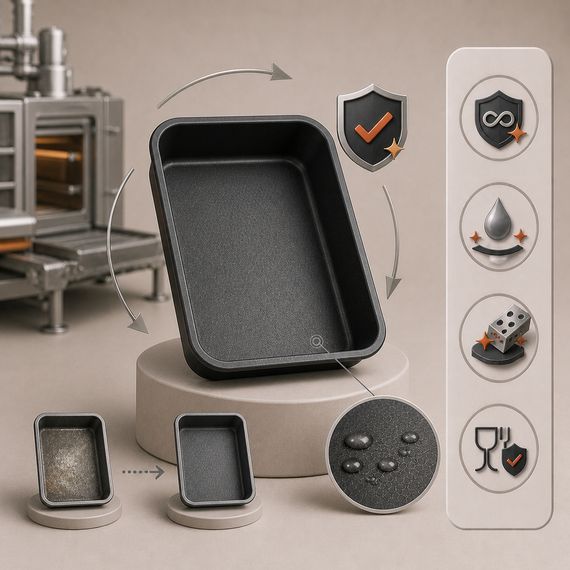
PTFE means polytetrafluoroethylene. In a non-stick coating system, it contributes a low-adhesion surface that can help dough and baked products separate from the pan. Release performance also depends on the recipe, deposits, surface condition and handling. A coating does not correct an unsuitable mold geometry or an incorrectly controlled baking process.
Do not use a generic polymer temperature range as the operating limit for a finished tray. The binder, primer, fillers, substrate and application all matter. Baking air temperature, metal temperature and local overheating are also different measurements. Use the written limit for the specified coating and equipment, including any restrictions on empty heating. The German Federal Institute for Risk Assessment’s PTFE guidance discusses the importance of avoiding overheating.
Multilayer coatings and Powergranit
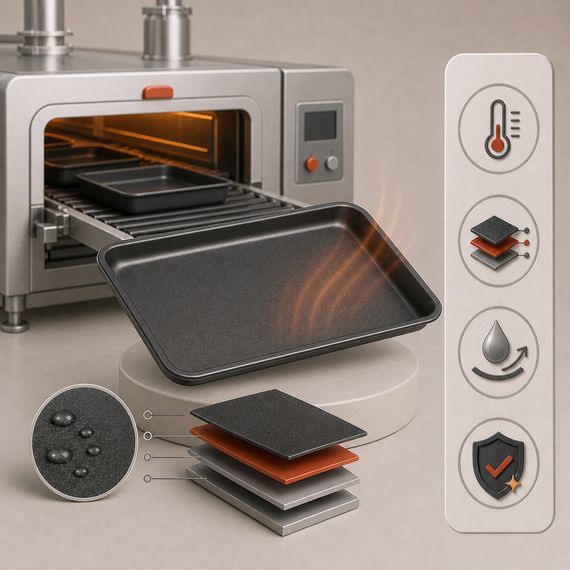
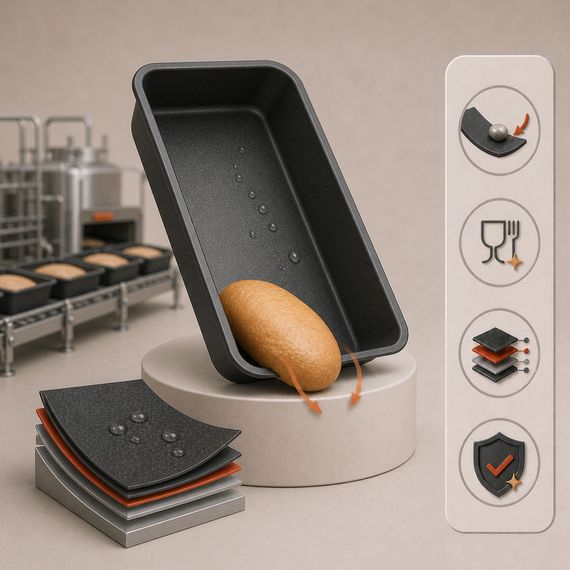
A multilayer system separates functions such as adhesion to the metal and product release at the working surface. More layers do not, by themselves, prove that a coating will last longer in every application. Surface preparation, curing, film thickness and the stresses encountered in service remain important.
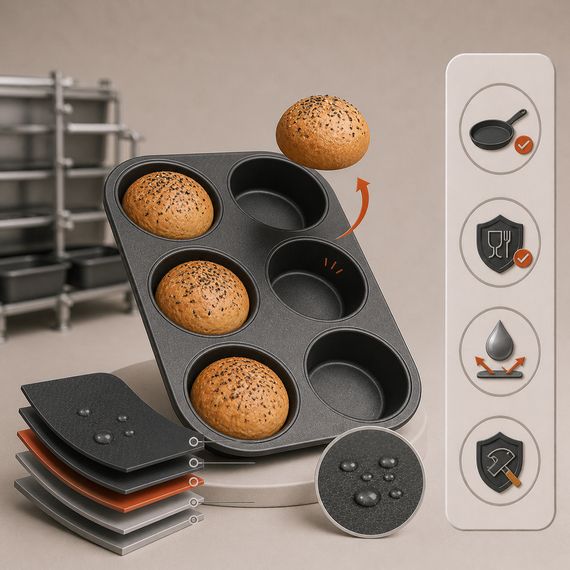
Örkon Kimya describes Powergranit as a four-layer PTFE coating. For a production application, request the relevant specification and compare the proposed system with the existing coating using the same recipe, cleaning method and handling conditions. Do not assume a fixed service-life extension or a guaranteed reduction in downtime without application-specific evidence.
Ceramic and silicone-based systems
Ceramic and silicone-based coating systems should be assessed by their individual technical documentation. A family name is not a complete specification. Release behavior, permitted temperature, resistance to the cleaning process and compatibility with the substrate can differ between formulations.
For products containing sugar, egg or other ingredients that form persistent deposits, test both product release and subsequent cleaning. For a proposed high-temperature application, confirm the limit of the complete system rather than transferring a temperature stated for another product or a different test condition. The same approach applies when comparing Powerseramik or Powersilikon with an existing coating.
What to include in a coating enquiry
| Information | Why it matters |
|---|---|
| Substrate and equipment condition | Identify the metal, repairs, deformation and remaining coating before deciding whether refurbishment is suitable. |
| Recipe and product format | Describe the dough, ingredients, portion size and release method used on the line. |
| Thermal cycle | Provide operating temperatures, dwell times, heating method and any empty-heating stages. |
| Cleaning and handling | Identify chemicals, cleaning temperatures, tools, stacking and automated handling contacts. |
| Food-contact conditions | Identify the destination market, food types and intended contact conditions for the compliance review. |
| Acceptance criteria | Agree how release, appearance, cleaning and coating condition will be assessed during a trial. |
Preparation, application and curing
Refurbishment starts with an assessment of the metal equipment. A new coating cannot restore a distorted frame, repair a crack or recover lost metal thickness. Repairs and dimensional checks should be agreed before the surface is prepared.
Removal of the old coating and surface preparation must suit both the substrate and the new system. A blasting medium, pressure or surface profile appropriate for one component should not automatically be specified for every tray. Application and curing must follow the selected coating supplier’s process requirements. A single curing schedule is not valid for all PTFE, ceramic and silicone systems.
Inspection can include surface coverage, appearance, thickness and adhesion checks where these are specified. Agree the methods and acceptance criteria before production, and retain the records needed to identify the coating system and processing batch.
Food-contact documentation is application-specific
Non-stick performance and food-contact suitability are separate questions. The relevant evidence must cover the actual coating system and intended use. For EU applications, the European Commission’s food-contact legislation overview describes the general framework and good manufacturing practice requirements. Additional rules depend on the material and application; a generic material name is not a compliance assessment.
A management-system certificate should not be presented as blanket food-contact approval for every coating or tray. Check the scope of certificates and request the material or finished-article documentation appropriate to the project. ISO’s certification guidance explains that certificates are issued by external certification bodies, not by ISO itself.
Comparing coating performance in production
Use representative equipment for a trial and record the starting condition. Compare product release, deposit formation, cleaning effort and visible wear over an agreed period. Keep the recipe, loading pattern and cleaning method comparable so that a change in process is not mistaken for a coating effect.
Assess refurbishment cost together with inspection, transport, equipment availability and expected maintenance requirements. A quoted coating price alone does not establish the lowest operating cost. Where performance data are unavailable, agree a trial rather than relying on an unsupported percentage saving or service-life promise.
Care and renewal planning
Follow the cleaning and handling instructions supplied for the finished equipment. Avoid unapproved abrasive tools and protect coated surfaces during stacking and transport. Inspect working areas and contact points regularly, and investigate changes in release before increasing cleaning intensity.
Before requesting a quotation, share equipment photographs, dimensions, quantities, the existing coating where known and the operating information listed above. This gives the technical team a basis for discussing the proposed coating and the checks needed before a production batch is approved.