
Controlled cooling after coating curing
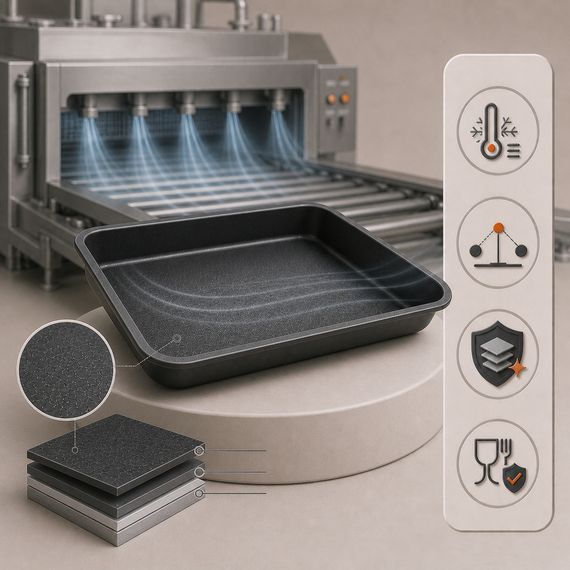
Cooling after coating curing is a broader process issue than simply making a part immediately ready for handling. The metal body, film structure, and part geometry must be considered together. A thin flat tray does not cool in the same way as a deep mold or a heavy process part. A controlled cooling plan records these differences.
Determining the rate for the part
Suitable cooling conditions should follow the selected coating’s technical instructions and process assessment. The same rate cannot be used for all PTFE, silicone, or ceramic systems. Slower cooling does not mean better results in every case either. Heating, holding, and cooling are assessed as a whole in the heat treatment file.
Temperature distribution may not be uniform when the part leaves the oven. An edge, mold bottom, or thick connection area may behave differently. The measurement plan needs to represent the actual load and geometry. Monitoring ambient temperature alone does not fully describe the part’s cooling history.
Handling and subsequent operations
- Part positioning and areas exposed to airflow.
- Acceptance conditions before handling or stacking.
- Protection of the surface against contamination.
- The final inspection stage and sample identification.
Immersing the surface in water during cooling or applying forced cooling without instructions does not replace an approved process. However, prohibiting every airflow method is not correct either; suitability is determined for the selected system and equipment. Process cooling and the transition to cleaning a pan during use should not be treated as the same procedure.
Final inspection and deviation records
After cooling, cracks, blisters, discoloration, and body flatness can be examined. Assess findings together with the thermal record. A defect cannot be attributed only to cooling; surface preparation and application history must also be investigated. Completing the programmed profile does not guarantee the absence of all defects.
If the same part will be processed under different loading arrangements, keep the records comparable. Do not compare two cooling charts by duration alone without knowing measurement points, load quantity, and ambient conditions. Assess the suitability of the new arrangement against the system’s acceptance criteria.
Share the part drawing, body material, and coating to be used in your inquiry to Powerpan. Clarify the cooling monitoring method and final inspection scope. Do not assume the presence of an automation system or dedicated chamber without specific equipment information. The aim is to establish a traceable process definition instead of a general claim that thermal shock is eliminated.