
Electrostatic coating: geometry and film control
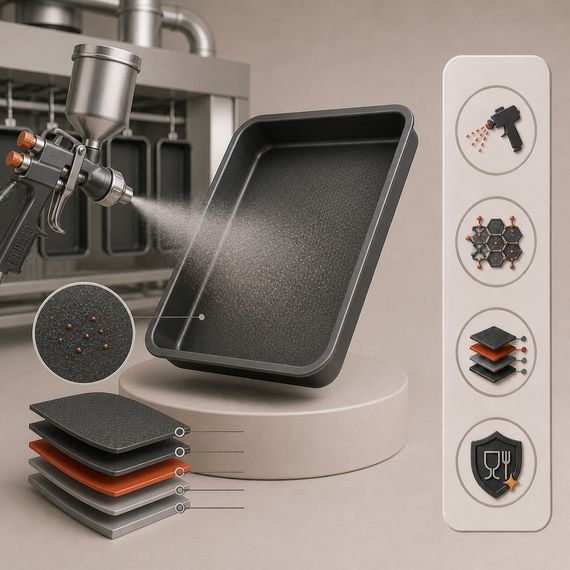
In industrial applications, the term static coating usually refers to material directed toward a surface by electrostatic attraction. Electrical charge is a process component that supports distribution; it is not the coating’s final non-stick or durability property. The material’s powder or liquid form and the part’s geometry are also assessed when selecting the method.
If the hanging point changes, recheck the part’s position and the surfaces that need coating. Using the same settings as in an earlier application does not prove the same distribution has been achieved. Records from recesses and connection areas are particularly useful in this comparison. Transferring an arrangement found suitable on a sample to a different geometry requires a separate assessment.
Why does electrical connection matter?
The application plan should include checks of the part’s grounding path, hanger, and contact points. Even after surface preparation is complete, part positioning and electrical connection may affect distribution. Define in advance how contact areas will be assessed after coating.
Open surfaces and recesses do not behave the same way in electrostatic application. Nordson’s technical checklist relates coating difficulties in holes, channels, and inside corners to the Faraday cage effect. The manufacturer’s explanation shows why expecting automatic full coverage in every area is incorrect; it does not establish which equipment Powerpan operates.
Matching inspection areas to geometry
- Film distribution across broad open areas.
- Coverage at the bottoms of recesses and inside corners.
- Buildup or thickness differences at edges and projections.
- Post-process condition at hanging and connection points.
Looking only at the front of the part may not be enough. Measurement points should represent the surface where the coating will be used and the difficult areas. An average value may hide an inadequately coated area. Compare results with the targets in the product’s technical instructions.
Film formation after application
Turning material attracted to the surface into a consolidated film depends on appropriate drying or heat treatment. Electrostatic attraction does not replace surface preparation or curing. Different formulations applied by the same method do not have identical use limits. Food contact compliance is assessed separately for the finished system.
Describe the part geometry, material information, and intended environment in your inquiry to Powerpan. Clarify the electrostatic application scope, inspection plan for difficult areas, and subsequent processing conditions. Instead of requesting a general percentage for transfer efficiency or full coverage, ask about measurement and acceptance criteria for the actual process. This connects the method name to specific product requirements.