
Baking pan spray coating: geometry and process control
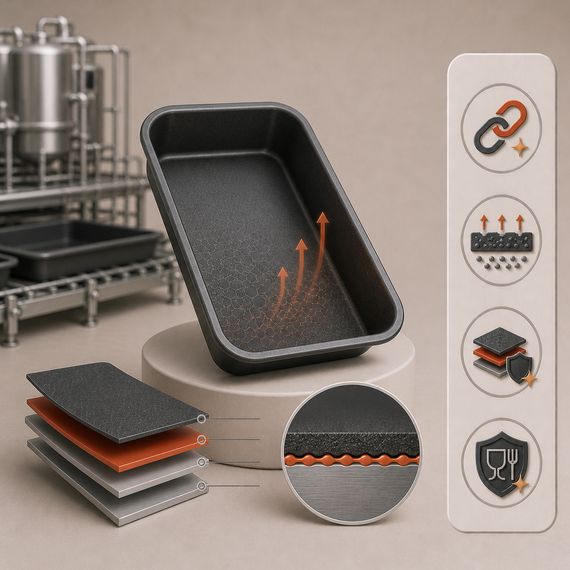
In baking pan spray coating, liquid coating material is sprayed onto the surface. Achieving the same film quality on flat bases, edges, and mold cavities depends on more than gun movement alone. Material preparation, surface condition, treatment between coats, and curing must be controlled together.
Inspection points for a pan group can be marked on a drawing. Records taken at the same locations on the open base, inside corner, and folded edge make later batches easier to compare. The suitability of the measuring instrument for that geometry must also be assessed. The thickness and integrity of the finished film should not be established solely from a wet surface that looks even during application.
Accounting for pan geometry in application
Pass overlap on the broad base of a flat tray, access to bottoms and corners in a deep mold, and the condition around openings in a perforated pan are separate issues. A thick area in one location and insufficient coverage in another may affect appearance and behavior in use. A single gun distance or pressure should not be treated as a recipe for every geometry.
Openings in perforated pans must be inspected after application. Residue or film buildup at corners and edges should also be examined. Film distribution cannot be described by an average measurement taken only from an open flat area.
Before application and between coats
Remove oil, old coating, and process residues using the method required by the new system. Check body deformation and surface loss during refurbishment. Include protection against recontamination while handling prepared surfaces in the work plan. A new coating does not mechanically correct a defective body.
- The coating material’s product code and preparation instructions.
- The intended film structure and inspection areas.
- Waiting or drying conditions between coats.
- A heat treatment record linked to part temperature.
For a multilayer application, define the compatibility of each coat and the conditions for moving to the next stage. More spraying does not automatically resolve inadequate adhesion or incorrect curing.
Delivery and production trials
Final inspection considers visual defects, film distribution, and an adhesion assessment suited to the equipment together. Product release can be examined in pilot use with the actual recipe. This trial does not replace food contact documentation; request compliance and maintenance information separately.
Specify whether the pans are flat, perforated, or molded, and share dimensions and current surface photos in your inquiry to Powerpan. Clarify the scope of the system to be applied and the inspection method at the quotation stage. Spray coating is a professional facility process; it should not be used as a pan refurbishment method at the customer’s facility with off-the-shelf aerosols or household tools. Lead time depends on part condition and process scope.