
Tunnel oven pan coatings and operating cycle assessment
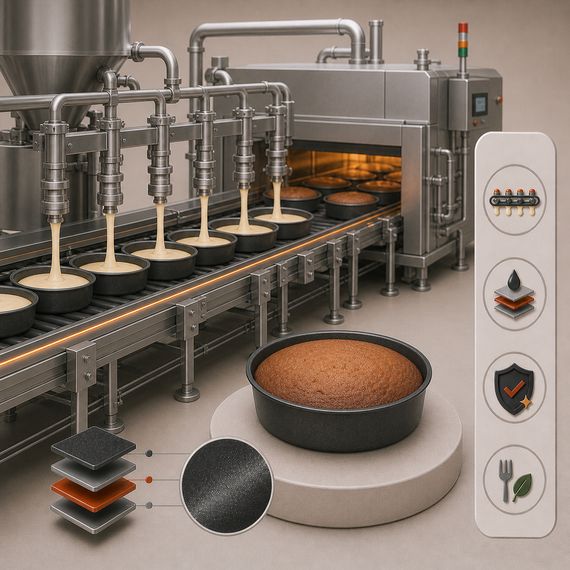
When assessing tunnel oven pan coatings, consider the conditions the equipment experiences not only inside the oven but throughout loading, unloading, and return. In a continuous production flow, a surface problem may become apparent during handling contact or product release. Describe the pan’s full cycle when sending an inquiry to Powerpan.
Heat information is more than a single number
The oven setpoint does not show that the pan reaches the same temperature in every area. Line speed, time in the oven, and conditions while empty pans are waiting all matter. Coating selection should be based on the limits specified for the system under the actual exposure conditions.
Do not infer high-temperature suitability from the name PTFE or ceramic. Distinguish continuous-use information from short-term exposure information. Direct contact with a heat source or exposure to an open flame requires a specific assessment; general nonstick information is not enough.
Observing handling wear
Examine separately the areas where the pan edge rubs, the loading fixture contacts the pan, or stacking pressure occurs. These contact areas may differ from the product-contact surface. Body bending and catching on the line should not be treated as problems that coating renewal alone can solve.
- The pan’s shape and how it sits on the carrier.
- Exposure inside the oven and return conditions.
- Contact during loading, unloading, and product release.
- The cleaning method and observed damage areas.
Do not use the same acceptance plan for different products
A bread mold, a flat cookie tray, and a specially shaped pastry pan require different surfaces and release behavior. During sample assessment, observe product release, surface residue, and equipment compatibility together. One successful trial does not establish results for every product group.
Old coating removal and preparation for the new system are professional processes. A fixed removal or curing temperature should not be directly applied to all pan bodies. The process plan is determined by the metal’s condition and the selected system.
Indicate the pan’s orientation on the line in damage photographs. Identify the leading edge, trailing edge, and return-contact area separately. This allows surface inspection to be matched to mechanical contact records.
Recoating and return to production
Share the pan quantity, line flow, and photographs of the problem with Powerpan. Recoating batches of sound equipment can be coordinated with the production schedule. Remove pans showing peeling from service for quality review. Do not assume uninterrupted production or a particular service life before line acceptance of the new surface and maintenance conditions have been established.