
Industrial cooking system coating
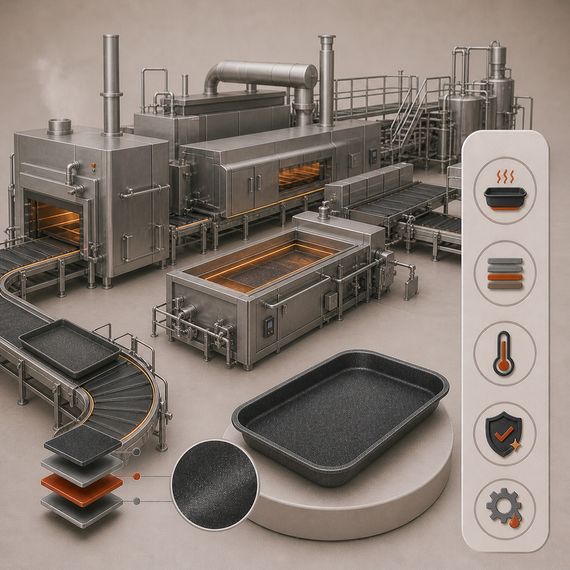
Coating an industrial cooking system starts with identifying the component to be treated. An oven pan, conveyor belt, internal panel, and heating element do not perform the same function. Extending a coating found suitable for a baking tray to every oven component does not define an appropriate technical scope.
In a tunnel oven, pans circulate on a continuous line, while rack and pan arrangements differ in a rotary oven. In convection systems, airflow and loading arrangements affect the baking result. A nonstick coating may aim to improve the surface in contact with the product; it should not be expected to correct the oven’s temperature distribution on its own.
Heat source and surface temperature
The oven setpoint does not indicate the temperature at every point on a coated part. Areas near the heater, operation without a load, radiant heat, and cooking time must be assessed separately. Grilling, griddle cooking, and high-temperature applications require the coating system’s service limits. The name PTFE or ceramic does not establish suitability for an open flame.
| System | Defining the scope |
|---|---|
| Tunnel oven | Assess pans, belts, and connections separately. |
| Rotary oven | Check pan arrangement and contact with the rack. |
| Convection oven | Distinguish the product-contact surface from the fan and internal panel. |
| Grill system | Verify the heat source and actual surface conditions. |
Preparing a renewal file
Send Powerpan photographs of the part, metal type, outside dimensions, cooking program, and cleaner details. Share any limits on surface modifications in the oven manufacturer’s maintenance instructions. Responsibility for disassembly, shipping, and reassembly should be included in the quotation scope.
A damaged body or connection is a separate maintenance issue to address before coating. Do not assume that heating elements, baking stones, or steam compartments can be coated. Technical acceptance is based on the component’s own function and the selected system’s documentation.
During trial production, record release behavior, the appearance of the product’s underside, and surface condition after cleaning. Baseline data taken without changing oven settings make comparison easier. Returning a renewed component to the line should include checks of mechanical fit and defined operating conditions as well as appearance.