
Conveyor line coating and conveying surface assessment
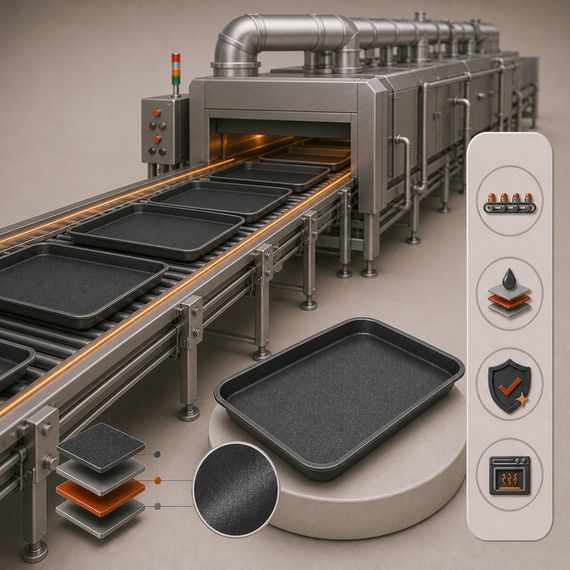
The goal of conveyor line coating is not simply to make the surface more slippery. Assess the grip required to convey the product, release at the transfer point, and cleaning needs together. An inquiry to Powerpan should clearly specify which belt or metal component you want processed.
Identify the conveyor type
Metal belts, wire mesh, and modular plastic carriers do not have the same material and movement conditions. A spiral arrangement or short transfer section can also create different contact conditions. Preparation and heat treatment suitable for one component should not be directly applied to another material.
In particular, do not assume that plastic modules can undergo the coating process used for metal components. Material compatibility and suitability for processing require separate assessment. Openings and connections in wire mesh, and joints and drive areas in moving systems, must retain their functions.
Do not overlook the grip required
Lower friction can be useful at some transfer points, but it can change the intended function during inclined conveying or at particular drive contacts. Product sticking to a surface and the carrier’s mechanical operation are not the same issue. Assessment should use the system manufacturer’s information and the actual movement conditions.
- The belt or component’s material and structure.
- The areas where the product makes contact and releases.
- Movement, tension, and mechanical contact conditions.
- Operating temperature and cleaning method.
- Connections and sensitive areas that must not be coated.
Narrowing the scope of work
It may be necessary to assess the problem surface or a removable component instead of coating the entire conveyor. Clearly define the scope of disassembly, transport, and installation. A general coating name is not evidence of applicability to a complete system or the availability of on-site service.
During the trial, check product flow, release at the transfer point, and mechanical movement together. A nonstick result alone does not show that line speed will increase or maintenance requirements will disappear. If food contact is involved, review the relevant material and usage documentation separately.
Where possible, show the transfer point with the product’s incoming and outgoing directions. Specifying whether residue recurs in a fixed area or along the belt makes the assessment more concrete. Maintain the normal product load and movement pattern during the trial.
Preparing a technical inquiry
Send Powerpan an overall system view, component details, and the stage at which the problem occurs. Suitability for processing, the system to be used, and the scope of service should be established after inspection. Remove components with separating coating from service; ensure that mechanical faults and surface damage undergo quality assessment together.