
Selecting nonstick coatings for bakery equipment
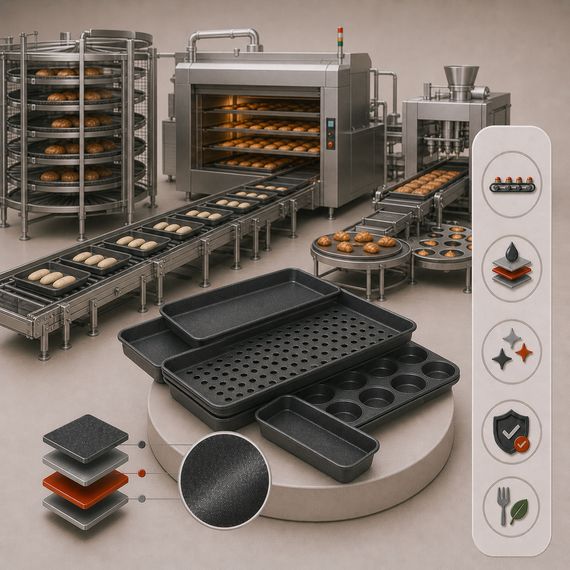
The need for nonstick coating on bakery equipment can arise at different stages, from dough preparation to product transfer after baking. Surfaces at these stages do not share the same temperature, movement, or product contact conditions. A coating assessment should identify where the problem occurs along with the equipment list.
Distinguish the process stages
Residue on a dough transfer surface, sticking in an oven pan, and product gripping a cooling carrier are different behaviors. Explain how the product makes contact and when it needs to release in each case. The nonstick objective should not change the grip required for the mechanical system to operate.
For baking pans, flat surfaces, patterned trays, and deep mold geometries become important. Connections and openings in moving components require separate assessment. General pan information also cannot establish whether cutting or slicing components can be coated; their sensitive functions and materials must be examined separately.
Operating information for selection
- The function of the component being considered for coating.
- The metal or other body material.
- The product and recipe in contact with it.
- Heat, movement, and contact with mechanical tools.
- Cleaning and procedures for removal from production.
A system used for one product group does not automatically provide the same result for another. Assess PTFE-based and other coating options using their own technical documentation. Frequent use alone does not require a particular brand or layer count.
New applications and recoating
For a new component, establish the intended use and acceptance criteria. For existing equipment, assess body deformation, corrosion, and previous usage history as well as coating condition. Do not apply a single preparation and heat treatment specification to all equipment.
Conduct the trial according to the relevant production stage. A result observed during dough transfer does not prove baked product release from a mold. Food-contact compliance and product performance are separate assessment areas; a general management certificate does not remove this distinction.
If assessment is requested for several pieces of equipment, match each component to its process stage. Preparing separate photographs and usage information for the pan, hopper, and carrier on the same list prevents confusion about application scope.
Make the service inquiry specific
Send Powerpan the component list, photographs, and operating conditions. Which components are suitable for processing and which areas need protection should be established after inspection. If a damaged coating is separating, remove the equipment from service for a quality assessment. Plan line acceptance of the new surface, the maintenance method, and the project schedule separately.