
Assessing nonstick coatings for bread production lines
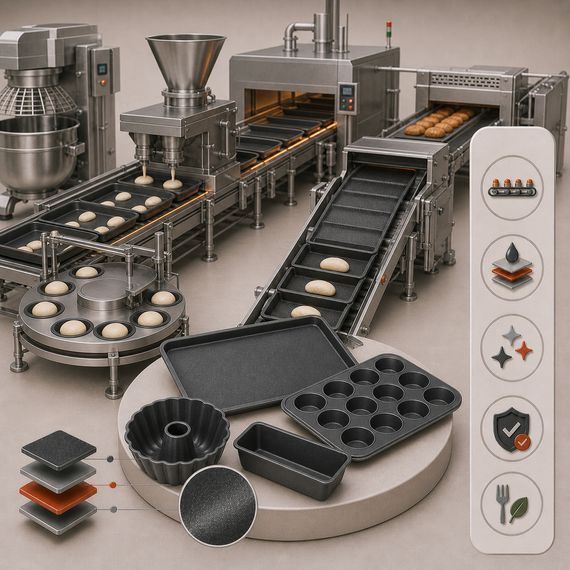
Dough sticking to a transfer surface and baked bread being difficult to release from a pan are not the same problem on a bread production line. A nonstick coating assessment starts by identifying the stage and surface where sticking occurs. In an inquiry to Powerpan, distinguish the relevant equipment and problem instead of describing the entire line as a single component.
Dough contact and baking surfaces
A transfer hopper, forming component, and baking pan may operate under different temperature and mechanical conditions. Dough moisture, surface contact time, and the release method also affect sticking. Directly applying a pan coating to every other component on the line does not replace a suitability assessment.
For a proofing carrier, the humid environment matters; during cooling transfer, how the product is transported becomes important. Assess both the grip required for transport and the product’s release from the surface. A more slippery surface does not mean better operation in every mechanism.
Map the problem
- The area where dough remains or baked product sticks.
- The relevant product recipe and process stage.
- Available information about surface temperature.
- Cleaning, greasing, and release procedures.
- Recent changes and photographs of damage.
If sticking occurs only in particular cavities or at an edge, a localized assessment is needed. Making decisions as though the entire line has the same problem can lead to unnecessary treatment of sound components. Define body bending or mechanical contact marks separately from coating loss.
Application and in-use validation
Removal of the old surface, preparation, and the coating system are professionally planned. Do not assume that every metal, belt, or moving component can be coated using the same preparation and heat treatment. A component’s suitability for processing is assessed along with how it is removed and its sensitive areas.
During a trial, keep the recipe and process unchanged while observing dough transfer or product release from the mold. Coating alone does not guarantee uniform baking, zero waste, or an increase in line speed. Food-contact documentation is also reviewed separately from these performance observations.
When investigating the same problem, record dough transfer residue and breakage of the baked product separately. This distinction helps establish the stage at which the trial should take place and what should be observed during acceptance.
Preparing a project inquiry
Share the component list, photographs, current problem, and production plan with Powerpan. The scope of work and operating limits should be established after the suitability assessment. Remove equipment showing peeling from production; do not continue using a damaged surface simply to keep production running.