
Dough production pan coating and transfer assessment
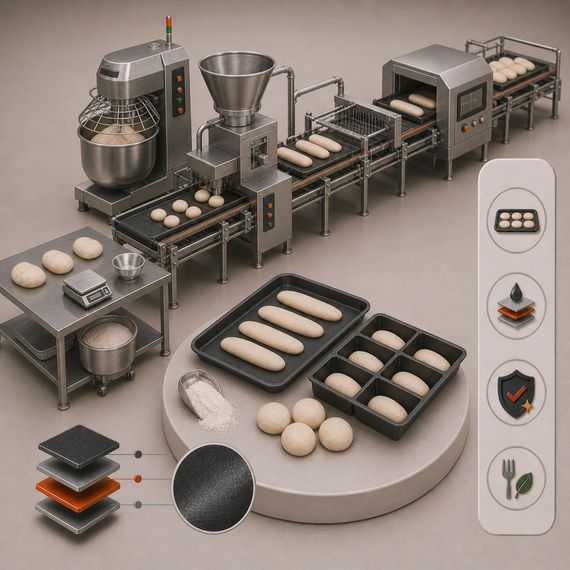
Assessing dough production pan coating is different from assessing baked bread release from a mold. During resting and transfer, how long the dough stays in the pan, how it is placed on the surface, and how it is released all matter. Specify the production stage at which the pan is used when sending a coating inquiry to Powerpan.
Resting and proofing conditions
Pans for intermediate resting, proofing, and in-process transport may have different holding arrangements. Consider humidity and temperature information together with the body material and cleaning. Use in a humid environment alone does not prove that a particular branded coating is suitable.
The dough recipe, flour or oil left on the surface, and holding time can affect observations of sticking. When the problem begins, record what has changed from previous conditions. Without this information, a coating cannot be selected on the basis of a single friction value.
Thin dough and transfer behavior
For thin dough sheets such as those used for yufka or börek, the release method and surface residue are particularly important. In a pizza dough resting pan, the product’s shape and removal procedure may be different. Successful transfer of one product does not guarantee that tearing will be prevented in another.
- The pan’s function and holding time.
- The dough recipe and how it contacts the surface.
- The release tool and transfer movement.
- Stacking contacts and body condition.
- Cleaning and storage conditions.
Body and coating inspection
Loading, unloading, and stacking can cause friction at the edges. Dents, bending, and corrosion are assessed separately from coating renewal. A new surface is not a separator that prevents pieces of dough from sticking to each other; its effect should be assessed only in relation to the equipment surface it contacts.
Professional preparation and application are planned according to the body material and selected system. Do not assume that every resting container can undergo the process used for metal pans. Confirm food-contact scope and maintenance conditions separately.
For stacked pans, check their arrangement both loaded and empty. Specify whether the underside of the upper pan contacts the dough or coating. Deformation seen after transport should not be recorded simply as surface sticking.
Trials and inquiries
Share photographs, the quantity, and the stage of use with Powerpan. During the trial, maintain the normal recipe, holding time, and release procedures while observing the dough surface and residue. Remove pans with peeling from service for quality assessment. Suitability for recoating or a new application, turnaround time, and delivery scope should be established through the project assessment.