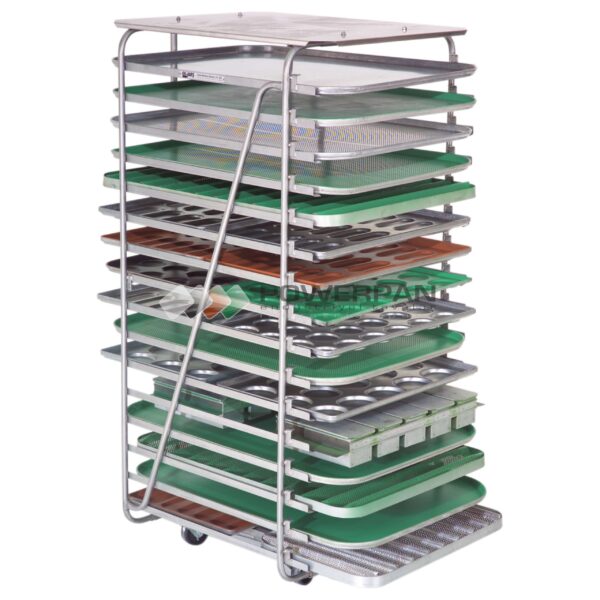
A tray cart is considered for organizing and moving trays between production, storage, and shipping. Empty tray stacks and product-loaded racks do not create the same placement requirement. In selection for Powerpan, define the trays to be moved and the route of use together.
A transfer cart and a cart that operates inside an oven have different requirements. Verify temperature conditions for racks and wheels separately. Trays fitting on the cart does not establish oven suitability. If use inside an oven is required, review the relevant product’s technical scope separately.
Rack layout and product clearance
In a racked structure, how the tray edge sits on its support matters. Trays with identical external dimensions may have different edge profiles. Check for binding, tilted placement, or rubbing against the coating using the actual tray.
Rack spacing must include the clearance the product needs during transport in addition to tray height. Structures such as open wire or sheet surfaces are assessed according to intended use. No rack type unconditionally guarantees cleaning, cooling, or coating protection for every product.
Route and loading
Include doors, aisles, turning areas, and floor thresholds in the external dimension and wheel assessment. Compare the combined load of trays, products, and cart with technical information. Load distribution must remain within defined use limits.
- Tray dimensions, edge profile, and quantity.
- Product height and required rack spacing.
- Transport route, floor, and washing conditions.
- Total load and contact with hot equipment.
Clean and used tray flows may be separated according to the facility’s own arrangements. A color or labeling system is a management option; do not assume it is standard cart equipment. Confirm current models and options when ordering.
A rack arrangement used for cooling and stacks in empty tray storage serve different needs. Clearance and access needed with loaded products must not be based on empty tray placement. If the same cart is planned for both tasks, check each loading method, cleaning flow, and movement space separately.
During maintenance, inspect rack connections, body shape, and wheels. Review hard contact points that cause coating wear. If damage prevents use, set the cart aside for assessment. Choose a cleaning method compatible with the material. Tray wear and time spent on transport can be tracked in use records; a fixed improvement rate cannot be calculated from cart selection alone.