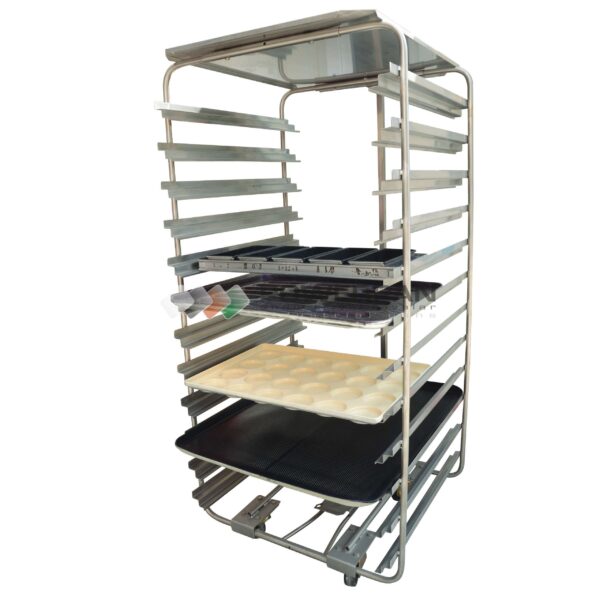
A rotary oven rack trolley carries trays in a compatible rotary oven and operates with the oven’s rotation mechanism. Connection to the oven, external dimensions, and shelf arrangement are central to selection. Share the oven make and model together with technical connection requirements when requesting a trolley from Powerpan.
Rotation alone does not guarantee the same baking result on every tray. Oven airflow distribution, loading arrangement, and product recipe also matter. A pan or tray fitting the trolley is not enough to show that the trolley is compatible with the oven mechanism.
Connections and operating clearances
Hanging, bottom connections, or other movement arrangements may vary by oven. Follow the connection points and movement clearances in the manufacturer’s drawing. Check tray edge profile and insertion direction as well as shelf width.
The trolley needs sufficient space to enter, leave, and rotate in the oven. Include product rise height in shelf spacing. Assess external dimensions, shelf count, and load information together; more shelves alone do not prove greater production capacity.
Load and temperature conditions
Include the combined load of empty trays, products, and trolley in the technical assessment. Load distribution across shelves and frame geometry matter. Verify suitability of wheels, connections, and other components for oven conditions through the relevant product information. Specifications for a transfer trolley cannot be transferred to a rotary oven trolley.
- Oven make and model and connection drawing.
- External tray dimensions and edge profile.
- Product height and shelf spacing needs.
- Total load, operating temperature, and cleaning method.
Confirm current model and custom-size options before ordering. Plan commissioning according to the oven manufacturer’s requirements. Check seating, movement, and tray positioning separately; if incompatibility appears, do not continue using the trolley by force.
Tray insertion direction and load distribution are part of the initial inspection. Movement that appears unrestricted with an empty trolley must be reassessed after adding products and trays. Shelf connections and the oven connection serve different functions; one looking sound does not show the other is suitable. Match operating conditions to the approved model information.
During maintenance, examine frame distortion, shelf connections, and moving components. Clean surfaces in a way compatible with the material and system used. Set a trolley with damage that prevents use aside for assessment. Assess baking results by considering trolley-oven compatibility, loading arrangement, and recipe together.