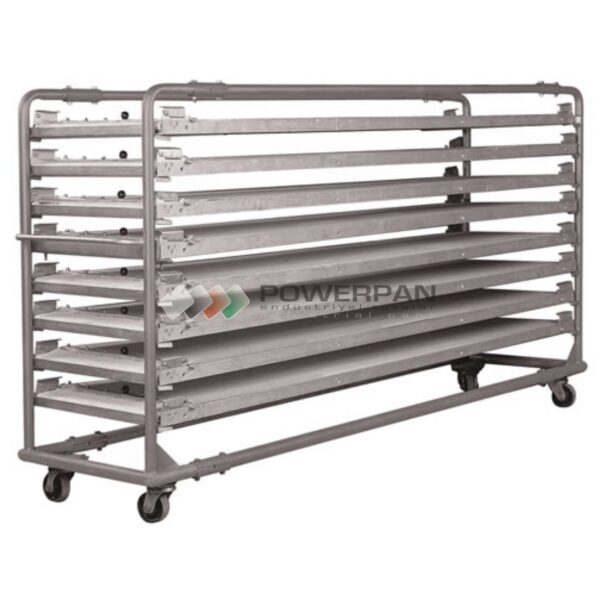
In baking, a dough-board trolley is wheeled equipment used to carry dough boards on multiple levels. Board dimensions, shelf support, and transfer of the dough to the next processing point are central selection factors. The industry’s use of the dough-board trolley term also refers to carrying dough boards; the name does not mean every trolley has a wire-mesh body.
First identify the dough board to be carried
Specify the board’s base construction, edges requiring support, and loaded condition as well as its external dimensions. It must remain on the shelves without slipping and be easy to remove during work. Assess rail spacing against the overhead clearance needed by the dough, not only the empty board.
Explain where the trolley will be used as well. Holding in a proofing area, transport between workbenches, and bringing boards to the oven front are not the same conditions. Do not assume a dough-board trolley can enter the oven directly or mechanically turn the dough unless the model’s function is explicitly confirmed.
Frame construction and operating environment
If open shelving, an enclosed structure, or wire mesh is required, describe each design separately. Wire mesh alone does not provide a hygiene guarantee. Cleanability of connections, access to corners, shelf surfaces, and wheel areas also matters. Confirm compatibility between frame material and cleaning chemicals in the technical instructions.
- Check support of the dough boards on the rails and ease of removal.
- Compare the loaded trolley with door openings and turning areas.
- Observe whether shelf spacing causes contact with or compression of the dough.
- Confirm brake, gripping point, and wheel options for the specific model.
Define how clean and used dough boards will be separated in the production flow as well. A trolley being easy to clean does not mean the cleaning step can be skipped. Check water-retaining areas, wheel housings, and shelf junctions after washing.
Load limits and ordering information
Shelf count alone does not indicate load capacity. The load on each shelf, total load distribution, and trolley movement conditions must match the manufacturer’s limits. Obtain the permitted load and area of use from product documentation; do not transfer one model’s value to another.
Share a sample of the dough board used, loaded dimensions, transfer method, and transport route in your inquiry to Powerpan. Confirm product construction, shelf layout, and any surrounding panels through a drawing. Remove a trolley with loose connections, bent shelves, or wheels that do not turn from service for assessment. This bases selection on the facility’s actual dough handling arrangement rather than a general trolley name.