
Process equipment coating
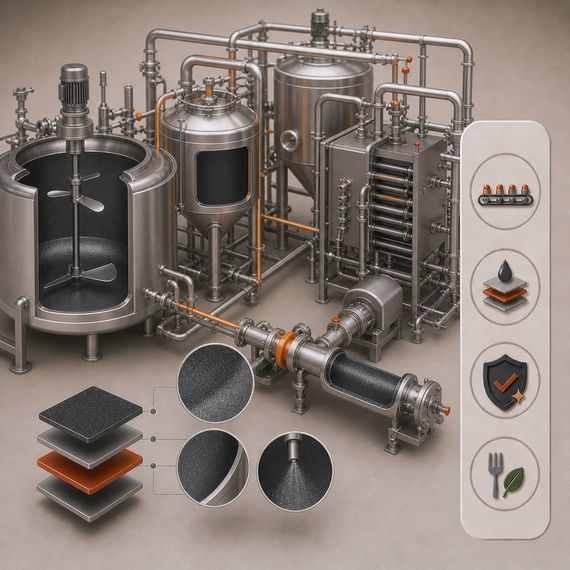
The first distinction in process equipment coating is between reducing product buildup and protecting a metal surface from chemical attack. A tank, reactor, pump, or pipe component may need both, but the same coating is not suitable for every chemical and mechanical condition.
A technical assessment requires the names and concentrations of substances in contact with the surface, operating temperature, pressure, and contact duration. Describing a substance simply as an acid or solvent is not enough. Cleaning chemicals matter as much as process fluids. Resistance data for a chemical do not automatically apply to its heated mixtures or different exposure durations.
Critical areas by equipment type
| Component | Assessment focus |
|---|---|
| Tank and reactor | Internal surface, welds, nozzles, and agitator contact |
| Pump and valve | Operating clearance and sealing surfaces |
| Pipe and connection | Access to internal surfaces and flange boundaries |
| Heat exchanger | Joint assessment of buildup and heat-transfer requirements |
A coating does not constitute a repair for mechanical pump wear or a damaged gasket. Changes to sealing surfaces must be assessed in relation to the equipment design. In a heat exchanger, the aim of reducing fouling must be considered alongside the film layer’s effect on heat transfer; energy savings are not promised in advance.
System selection and inspection scope
Material families such as PTFE, FEP, PFA, or ECTFE may be options in a technical discussion. A particular product’s chemical resistance, film structure, and temperature limit must be verified from its own technical documentation. General properties of a material family do not prove that Powerpan can coat a particular component or guarantee the outcome.
State surface preparation, areas to be masked, and the inspection method in the order scope. Thickness, adhesion, or porosity checks are determined by the selected system. A single inspection result should not be interpreted as documentation of resistance to all chemicals.
Send Powerpan drawings, part dimensions, photographs of existing damage, and operating information to request a feasibility assessment. Separately plan disassembly, transport, and reassembly conditions. If blistering, coating separation, or signs of underfilm corrosion appear during use, segregate the equipment and do not return it to normal operation before the maintenance assessment is complete.