
Baking Terminology
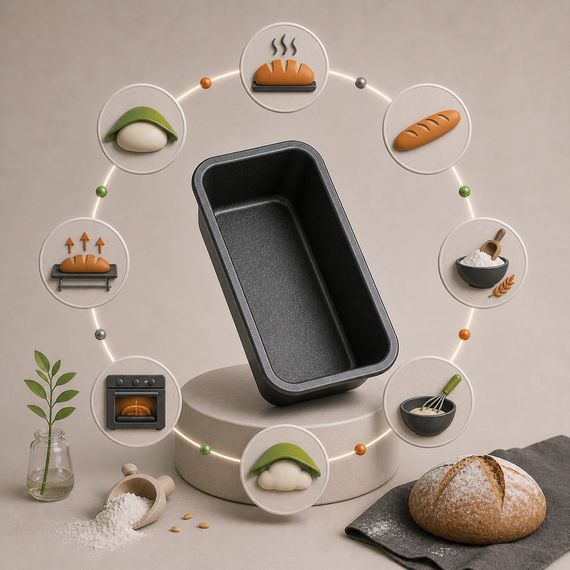
Using bakery terms consistently makes many tasks easier, from ordering pans to keeping production records. When sharing dimensions, capacity or production loss data in particular, specify the product and the scope of the calculation.
Pans, molds and handling equipment
Baking pan or tray
The equipment that holds the product during baking. External dimensions may differ from the usable area where the product is placed. The material, edge construction and surface specifications must also be defined in the order.
Mold and mold cavity
A mold is equipment that helps shape the product. In a multicavity design, each section that holds a product is called a cavity. Along with the cavity count, cavity dimensions and spacing determine product layout.
Baguette pan and loaf pan
A baguette pan may have shaped sections suited to holding long loaves. A loaf pan is a type of mold used to produce pan bread; lidded and unlidded versions should be specified separately. The name alone does not define the dimensions.
Oven rack
A carrier designed to transport pans or hold a batch of pans in a compatible oven. Check rail spacing, loading direction and oven compatibility; a similar appearance does not prove compatibility.
Ovens and heat transfer
Tunnel oven
An oven arrangement in which a conveying system moves the product through the baking zone. Line operation and zone settings vary with the equipment.
Rotary rack oven
A type of oven that rotates a compatible pan rack during baking. The rack’s dimensions and connection arrangement must be checked against the oven model.
Conduction, convection and radiation
In conduction, energy is transferred through a material or across contact surfaces. Convection involves the movement of fluids such as air, while radiation involves electromagnetic energy transfer. These mechanisms may act together during baking; the coating alone does not determine all heat transfer.
Production records and performance
Cycle
A repeated sequence of operations. The beginning and end of a pan cycle must be clearly defined in the recording system. Baking time alone differs from the total time until the pan is ready to be filled again.
Line capacity and bottleneck
Capacity is the quantity that can be produced per unit of time under defined conditions. A bottleneck is the stage that limits the rate of flow. The oven’s nominal capacity does not always equal the line’s actual output.
Production loss
Product loss resulting from failure to meet defined acceptance criteria. Loss rates based on unit count and weight must be calculated separately. A percentage without a specified numerator and denominator is not suitable for comparison.
Pan fleet and total cost of ownership
A pan fleet is the group of pans an operation keeps in circulation, under maintenance and in reserve. Total cost of ownership is an evaluation that includes relevant operating expenses as well as purchase or recoating costs over a selected period. The expenses included must be stated.