
Evaluating baking tray coating insulation claims
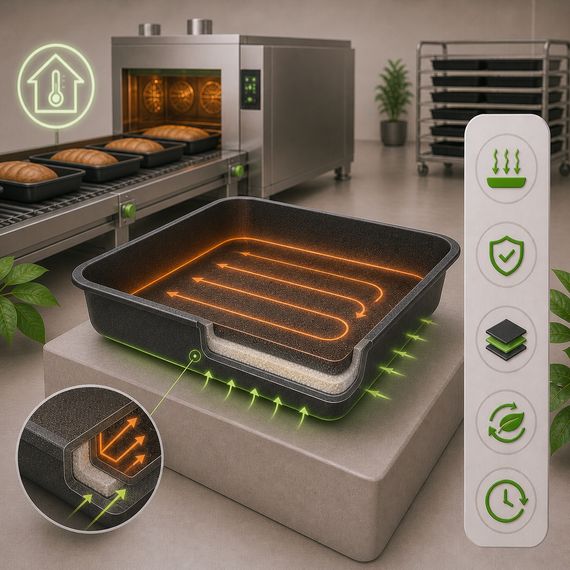
The term heat-insulating tray coating should not be used as a synonym for a nonstick surface. In many baking applications, the tray’s role is to transfer heat to the product. Reducing heat transfer does not always deliver better baking or lower energy consumption. First define the thermal behavior required at each surface.
The interior surface and exterior base have different purposes
Heat transfer at the food-contact interior is evaluated differently from that at the exterior base where the tray contacts the oven rack. Sidewalls, corners, and connections do not share the same geometry either. Where the coating is applied should not be determined solely by a general expectation of insulation.
A coating material’s low thermal conductivity does not by itself prove that a thin film provides meaningful insulation on a finished tray. Film structure, thickness, and the complete metal body must be examined together. Generic PTFE values or a brand name should not replace insulation performance data for a specific product.
Insulation, heat storage, and even baking
Reducing heat loss, the tray’s heat storage, and uniform surface temperature are separate topics. A surface cooling more slowly does not show that every point is at the same temperature during baking. Monitor the ends and middle of a long bread mold separately, and the edges and center of a broad tray separately.
- Clearly define the intended thermal property.
- Specify metal type, geometry, and coating areas.
- Record heating, baking, and cooling conditions.
- Evaluate product quality alongside temperature measurements.
Data to request during technical discussions
Part dimensions, the oven program, and the current baking problem can be sent to Powerpan. Write the insulation request separately from the product release request. If thermal data for the selected system are unavailable, do not claim an insulation result for the finished tray. Food-contact and operating-temperature documentation are also included in the assessment.
The trial should use the same product, load, and oven conditions. Earlier or later baking alone is not interpreted as energy efficiency. Results should show both quality acceptance and measurement conditions. Coating does not correct body damage; high-temperature applications require system-specific verification. Until the insulation expectation is explained through these data, it should not form part of a general nonstick surface promise.
A coating proposed for the exterior may also change the tray’s contact with a rack or conveyor. Check this mechanical contact alongside the thermal objective. A trial result for the interior cannot be transferred to the exterior base. Defining each area’s function allows insulation expectations to be evaluated without overlooking product release or line fit.