
Evaluating coating technology and energy use
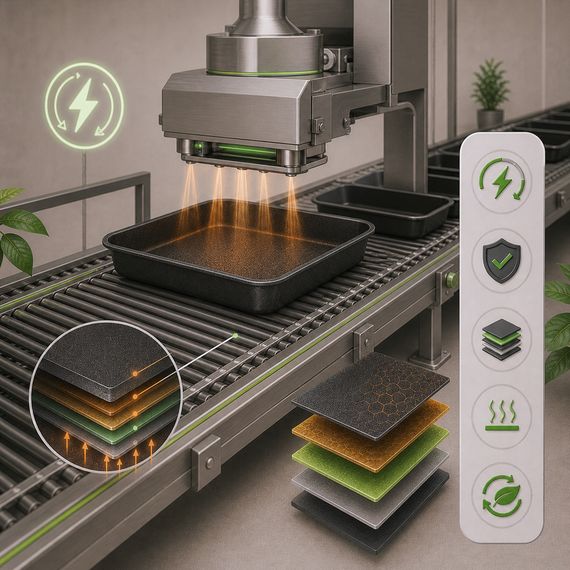
For energy-efficient coating technology, a material name is not a performance result. PTFE, silicone-based, and ceramic-based surfaces may have different formulations and application structures. A system’s effect on baking energy must be assessed through the finished coating’s properties and the full production conditions.
Why is a single material value insufficient?
Examine the coating’s thermal conductivity, film thickness, and behavior together with the metal body. A generic polymer value cannot establish insulation or faster baking for a finished tray. Surface color and appearance alone should not be treated as a measure of radiant heat exchange either. Technical data for the relevant coating system are needed.
Low friction or easy product release does not prove that the oven bakes the same product with less energy. These are different operating indicators. If surface refurbishment reduces product loss, that change is evaluated separately in the energy calculation per unit of accepted product; it is not recorded as savings without measuring its effect.
Evaluate the coating with the oven system
The U.S. Department of Energy’s process heating guides cover areas such as air infiltration into furnaces, radiation losses, and controls alongside heat transfer surfaces. DOE process heating resources provide a framework for avoiding an energy assessment reduced to a single surface property.
- Define the metal body and tray shape.
- Record oven load, operating time, and program.
- Monitor product acceptance and consumption in the same trial.
- Evaluate cleaning and baking energy separately.
Energy claims in a quotation
Share actual operating conditions when discussing a coating request with Powerpan. If the expectation is product release, specify its acceptance criterion; if it is a change in energy use, specify the measurement plan separately. Data obtained under the same conditions are needed before ranking brands or layer structures by savings.
A lower temperature or shorter time that does not maintain product quality should not be presented as an energy efficiency result. Food-contact documentation and operating limits should also form part of the technical assessment. Comparing the same recipe and oven load after coating allows a more meaningful interpretation of consumption changes. General physics does not prove that a particular Powerpan product will save energy.
When comparing surface systems, keep observations for clean and used trays separate. Accumulated residue or changing surface condition may create conditions different from the initial trial. Record initial and long-term operating results using the same measurement plan. This prevents the technology assessment from resting solely on the new coating’s appearance or a single production batch.