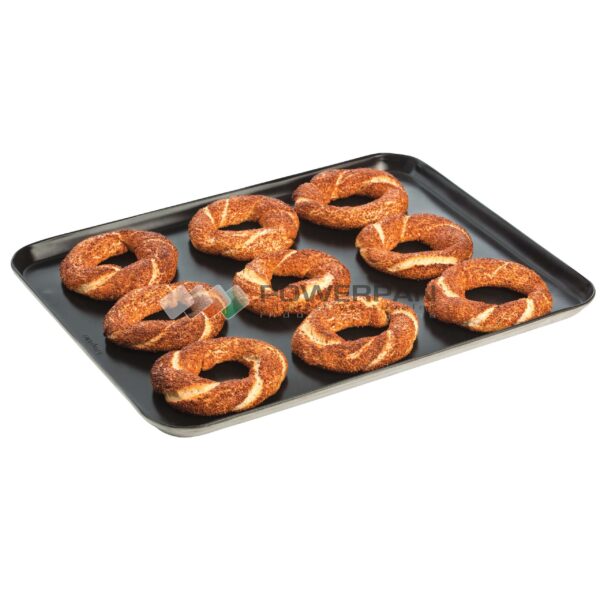
Choosing a shared tray for simit and poğaça requires assessing how both products behave on the same surface. Their recipes, dough shapes, and baking expectations may differ. In a simit and poğaça tray request to Powerpan, share use information for both products.
A single tray group may simplify inventory management, but this is not true for every facility. Cleaning between products, production scheduling, and oven layout are also part of the plan. Separate trays should not be called unnecessary, nor should a shared tray be said to deliver certain savings.
Comparing solid and perforated bases
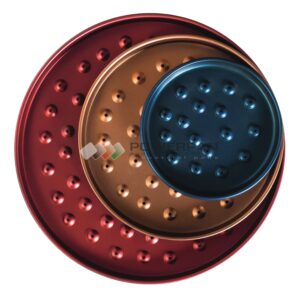
On a solid surface, dough remains in continuous contact with the metal base. On a perforated surface, assess the opening pattern and product contact with those openings together. A structure considered suitable for simit does not mean poğaça will produce the same result. Trials with both recipes make selection more concrete.
Product layout must allow for expansion and possible contact with neighboring products. The number that fits on a tray may differ from the number that can bake while retaining the target finished shape. Assess actual capacity through recipe and layout trials.
Sesame seeds and product residues
Inspect areas where sesame seeds, poppy seeds, or dough residues accumulate. A nonstick surface does not reliably prevent every particle from adhering. Check hole edges and tray corners separately during cleaning. Include information about fatty dough in system selection.
- Simit and poğaça recipes and target product shapes.
- The need for a solid or perforated surface.
- Oven dimensions, program, and layout.
- Release agent, cleaning, and product changeover conditions.
Assess coating operating limits and food contact scope for the relevant system. First-use preparation is not the same for every surface; do not follow an uncontrolled recipe for greasing and holding in the oven. Metal scraping can damage the coating.
Record the residues and removal method for each product separately. One recipe may leave more oil on the surface while another leaves more dry particles. A shared-use trial must also include cleaning between products; do not assess only each product’s first baking result.
Handle new tray and refurbishment requests separately. An old body requires inspection for deformation and corrosion. Remove trays showing layer separation from production for inspection. Establish suitability for shared use by confirming current product options and order scope.