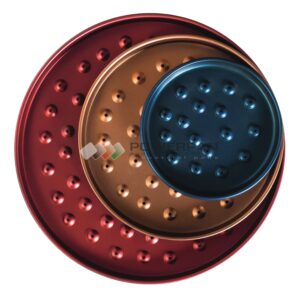
Conical cake molds are considered for ring-shaped products with their central opening and sloped walls. Choosing a plain or patterned surface changes the finished cake’s appearance. Names such as Gugelhupf, Bundt, and savarin may refer to similar mold shapes, but their recipes and intended uses must not be treated as identical.
Read every dimension of the cross-section
Evaluate lower and upper openings, the center tube, and depth together. In a conical shape, width can change at different heights. Overall diameter alone does not show the space available for batter or the target portion count. Compare the technical drawing with the required product shape.
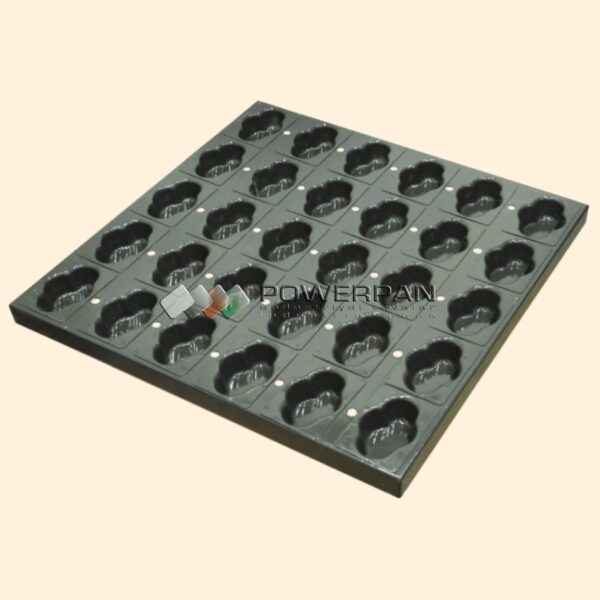
If several cavities on one carrier are planned, specify each cavity’s cross-section and spacing separately. A single large mold and multiple small cavities have different filling and removal arrangements. Do not assume that every mold in the product group is supplied with the same cavity count.
Pattern definition and surface contact
Recesses and projections on patterned walls form the surface that contacts the batter. In a sample, inspect complete pattern filling, release of the baked product, and integrity of fine details. A deeper pattern or more pronounced taper does not mean easier release with every recipe.
- Share lower and upper widths, tube dimensions, and depth.
- Specify the plain or patterned appearance with a drawing or sample.
- Explain the batter recipe and filling method.
- Record the pattern, area around the center, and base result in the sample.
- Test removal and subsequent sauce or decoration application.
The central opening does not guarantee a particular baking time or even baking throughout the cross-section. Test filling and the oven program with the recipe. The serving method for a product used with sauce can also be included in the mold request; the mold name should not be treated as approval for a specific recipe.
Cleaning recesses
Clean pattern recesses and tube junctions with tools suited to the surface. Separating the product with a metal knife or scraping recesses can damage the coating. Select the system based on operating temperature and cleaning conditions.
Segregate molds with lifting coating or pattern or body deformation. Clearly showing the target cross-section and pattern in a request to Powerpan helps match the conical ring mold to production expectations.