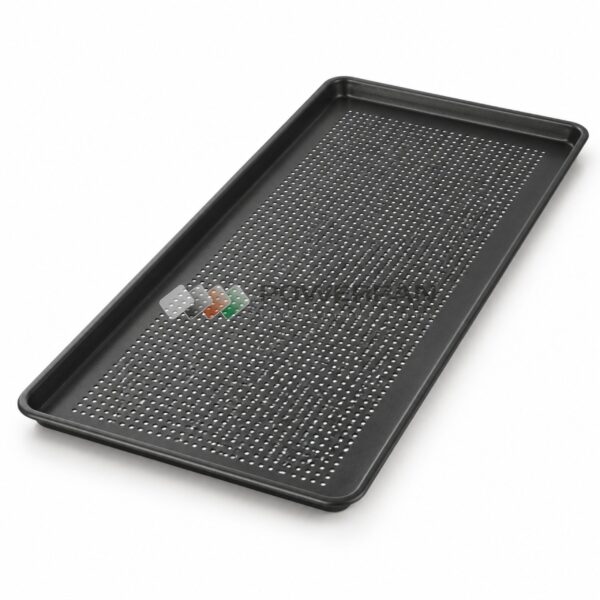
The 40×80 perforated tray is a longer baking format that retains a nominal width of 40 cm. Its perforated base creates a distinct surface arrangement affecting airflow and moisture movement beneath the product. Choosing a longer tray should be assessed not only for additional product placement but also alongside oven, handling, and cleaning workflows.
Assessing products at the two ends of the long tray separately reveals local differences. Describing the entire tray with a single average result can conceal recurring release or baking difficulties in a particular area.
Checking long-format compatibility
If moving from a 40×60 tray, matching width is not enough to establish rack compatibility. Check rail length, support spacing, and loading movement. Also review cart clearance and the areas where trays contact each other during stacking for the new format. External dimensions and usable internal area must be shown separately on the drawing.
More nominal area does not mean a proportional increase in product count. Product size, expansion, and spacing determine the layout. Observe the long surface’s position inside the oven during the pilot trial as well; baking differences should not be attributed to the tray alone.
Hole layout and recipe
Select hole diameter, spacing, and pattern in relation to the product base. For products such as simit or açma, assess the target texture using the actual recipe. Record dough protruding into openings, marks on the underside, and difficulty during removal separately. The same perforated structure is not automatically suitable for fluid mixtures.
- Product distribution along the long base.
- Baking appearance in the front, middle, and rear areas.
- Residues and dough buildup in openings.
- Coating integrity and product release.
Coating and daily operation
Identify the PTFE or other system option by product code and use instructions. Include hole edges in the final inspection plan. Check the condition of the openings after application separately from film appearance. A coating name should not be used to infer a fixed temperature or service-life value.
During cleaning, remove residues around the holes with suitable tools; do not scrape with metal points. Plan drying and stacking of the long tray so surfaces do not rub. If peeling or flaking occurs, set the equipment aside for quality assessment.
In a quote request to Powerpan, share the 40×80 format, target product, and oven and rack information. Confirm hole layout, external dimensions, internal base, body, and coating selection through a technical drawing. Establish capacity and baking time through controlled production trials, not a percentage of nominal area.