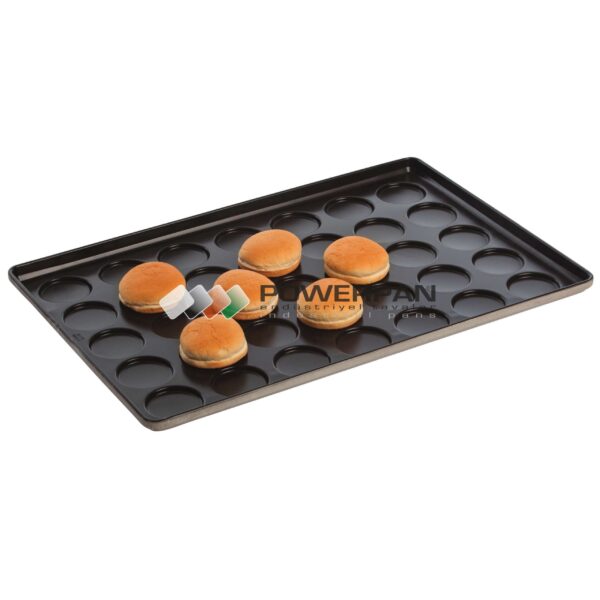
A small hamburger bun pan is considered for baking small hamburger buns, such as those used for mini burgers and sliders, in round cavities. Small does not correspond to a fixed dough weight. Define target baked bun dimensions, serving format, and recipe together.
Small cavities and the right dough load
Cavity diameter and depth provide space for dough expansion. Different recipes placed in the same cavity can produce different finished bun dimensions and heights. Do not select fill quantity solely from a catalog weight; determine it through proofing and baking trials.
Cutting height matters for a mini product. Check that the bottom portion remains intact when filling is added, the top is easy to hold during serving, and the product fits its packaging. A small bun does not imply an appropriate portion for a particular age group or a nutritional advantage; select the mold using technical dimensions.
Cavity count and production flow
Smaller cavities may allow a different number of products on the same carrier. However, daily capacity must not be inferred from cavity count alone. Assess filling, proofing, baking, cooling, and removal together. Test individual transfer of small products with the existing equipment too.
- Specify internal cavity diameter and depth.
- Define target product weight separately from dough load.
- Share filling and product removal equipment details.
- Observe upward expansion, the base, and cutting behavior in the sample.
- Check serving fillings and package dimensions.
Cavity centers and spacing should be visible in the technical drawing. Check during the trial that dough does not touch neighboring products at the end of proofing. If a surface treatment is applied, assess whether the tools used can reach the small cavities.
Coating and repeated production use
Match coating selection to dough and oven conditions. Do not assume a particular cycle count or number of service years without measured product data. State greasing and washing routines clearly in the technical discussion.
Clean cavity bottoms and edges with suitable soft tools; do not scrape the coated surface. Segregate pans with damaged coating or deformed cavities. Providing serving and production dimensions alongside the name mini bun in a Powerpan request allows the small-cavity mold to be assessed against actual operating needs.