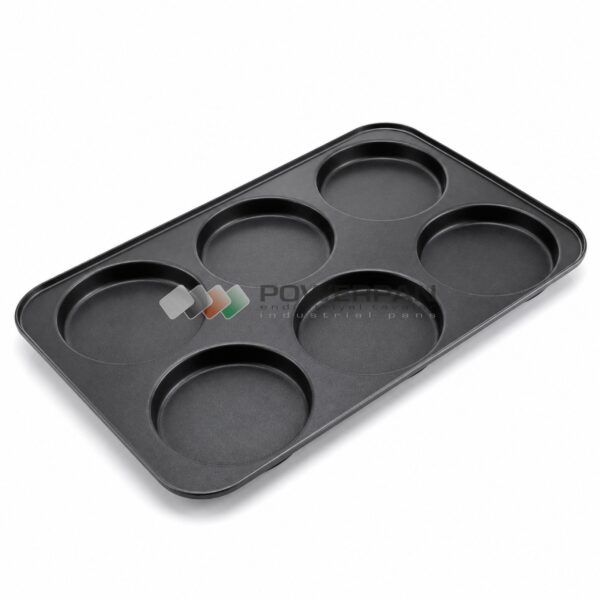
A large hamburger bun tray is defined as a round multicavity mold for production targeting wider hamburger buns. Large alone is not an order dimension. Cavity diameter, depth, and overall dimensions must be clearly specified in the mold drawing. The requested cavity dimensions should be matched to the selected product code.
Balance the filling and the bread
A wide bun is evaluated alongside the placement of the patty and other ingredients. A larger diameter does not show that every filling will be supported without falling apart or that the product will be higher quality. In the serving trial, check the visible proportions of patty and bread, slicing height, and package closure.
Increasing dough quantity changes more than diameter; crumb structure and baking requirements may change too. Conduct a recipe trial before applying the same oven program to different sizes. Evaluate the bread’s center, edges, and base separately to identify necessary adjustments.
Plan the tray layout together
Allow space between large cavities for dough development and surface applications. Read cavity count, overall tray dimensions, and spacing together in the technical drawing. A tray that seats on the existing oven rack is not automatically compatible with filling or depanning equipment.
- Provide target diameter and height for the finished bun.
- Share usable dimensions of the slicing machine and packaging.
- Specify dough ingredients and the current baking program.
- Test slicing, filling placement, and surface release in the sample.
Protect the surface
Coating selection should be independent of large-size or premium menu names. Evaluate greasing arrangements, recipe, frequency of use, and cleaning method together. Request the system’s technical conditions without turning a coating name into a promise of fixed life or operation without greasing.
Do not scrape residue inside cavities with metal tips; use surface-appropriate cleaning tools. Set aside and inspect a tray showing scratching, lifting, or distortion. Supporting a request to Powerpan with dimensions and a sample product, rather than the menu’s large-size description, clarifies mutual expectations.