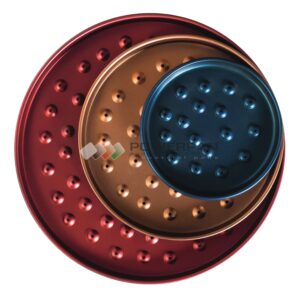
A custom pan inquiry may require a broader assessment than making a standard tray larger or smaller. Product shape, oven placement, handling arrangements, and how staff grip the pan affect one another. A well-defined inquiry states clearly which need the design must meet and under what conditions it will be accepted.
Make requirements measurable
First establish the intended shape and portion of the finished product. Then describe external pan dimensions, internal cavity dimensions, cavity depth, and layout separately. Two pans with the same overall dimensions may behave differently on the production line because of different edge construction or cavity spacing.
If an existing pan is supplied as a reference, list separately the features to retain and those to change. For example, the cavity shape may need to change while external dimensions remain fixed. Copying every dimension may also carry the old product’s operating problems into the new design.
Production line contact points
| Area | Information to share |
|---|---|
| Oven | Shelf or carrier dimensions, support points, and operating conditions |
| Handling | Trolley rails, stacking method, and gripping areas |
| Product | Cavity shape, target cross-section, and dough placement |
| Cleaning | Washing method, chemicals used, and access requirements |
If loading or unloading is automated, describe the surfaces contacted by the equipment separately. An edge suitable for manual handling is not necessarily suitable for a robot or mechanical gripper. This compatibility is a separate requirement that must be verified through dimensions and trials.
Drawing and sample acceptance
Before production, record the approved drawing version, measurement points, and agreed tolerances. Do not assume the same level of precision for every inquiry. Distinguish locations requiring a tolerance from dimensions that describe only the general form.
Assess the sample with the actual recipe and working arrangement. Add release, oven loading, handling, and cleaning trials to appearance checks. If the design changes, reassess which parts of the earlier approval remain valid.
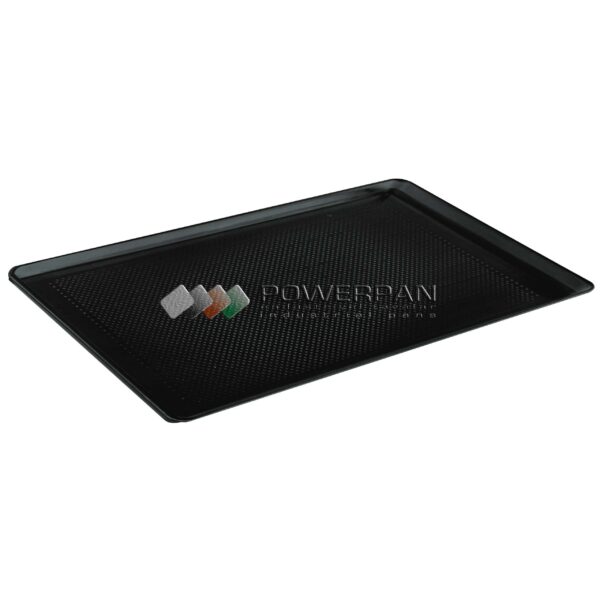
Existing equipment photos, a dimensioned drawing, and a target product sample complement one another in a custom pan inquiry to Powerpan. Confirm the feasibility and service scope of additional requests such as a perforation pattern, special marking, or different connections at the quotation stage. Lead time and order quantity cannot be inferred from the design itself; establish them separately.