
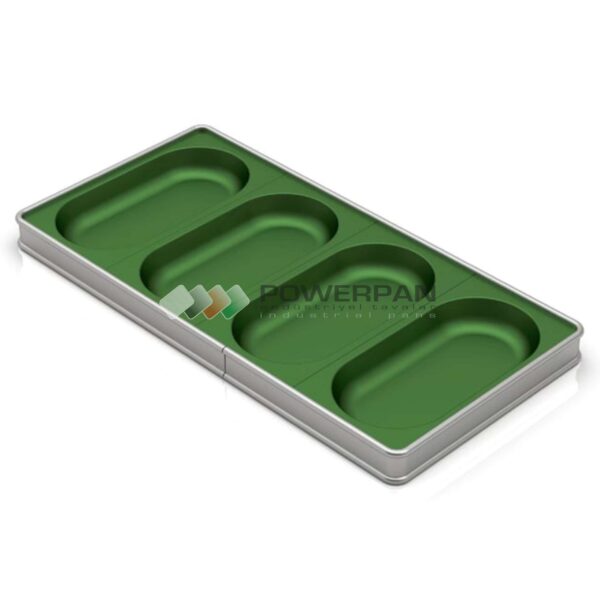
Custom-mold trays use shaped cavities or impressions to support a defined product form. The design may concern bread, pastry, or another baked item, but the geometry must work for production as well as appearance.
Turn the shape into a usable brief
Provide section views, dimensions, depth, and the product mixture or dough. Identify details that must appear on the finished item. Fine features need review for forming, coating access, release, and cleaning; a concept image is not proof of feasibility.
Consider the tray around the mold
Cavity spacing, support edges, and reinforcement must suit the line and handling method. Describe cooling and demolding. A coating cannot guarantee that every detailed shape will release intact or reproduce the same impression with different recipes.
- Supply a reference product or design.
- Identify the operating and cleaning cycle.
- Confirm permission for branded shapes or logos.
- State relevant food-contact evidence requirements.
Agree a drawing revision and any sample assessment before committing to the configuration. Feasibility and commercial scope require confirmation for the actual design. For renewal, inspect lost or damaged metal detail separately from coating wear rather than expecting a new surface to recreate it.