
Reusable baking tray coating and maintenance
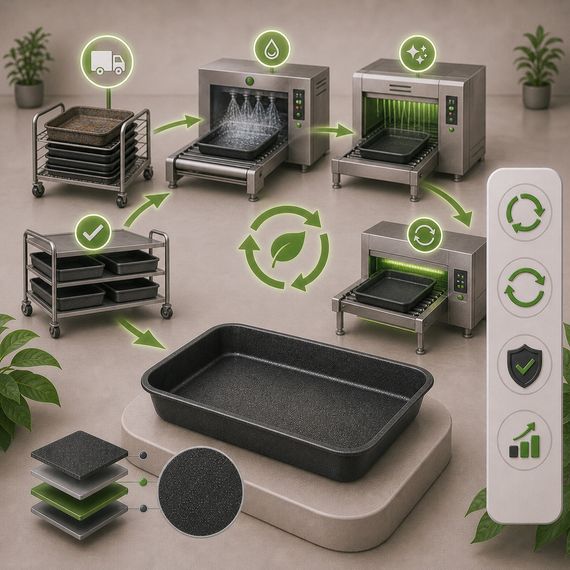
Coating reusable baking trays requires evaluating how the same equipment’s surface behaves over successive production cycles. A tray being reusable does not give its coating an unlimited life. The soundness of the metal body, product release, and cleaning conditions should be part of every operating plan.
The cycle involves more than the oven
The tray is loaded, goes through baking, has its product removed, is cleaned, and is prepared again. Contact with carriers and during stacking is also part of this cycle. Focusing only on oven conditions without identifying where coating wear occurs can leave the assessment incomplete.
The daily cycle count can be shared during technical discussions, but specific counts do not directly determine whether a single-layer or multilayer system is selected. Product recipe, actual temperature, cleaning chemistry, and mechanical contact should be considered together. The same number of cycles can impose different demands on different equipment.
Conditions for reuse
- The body and connections must be suitable for production.
- The cleaning and sanitation method must be compatible with the coating instructions.
- Surfaces must be protected from unnecessary rubbing during handling and stacking.
- Damage and product release must be tracked by tray or batch ID.
Do not assume that a nonstick surface will eliminate oil or parchment paper for every product. Changes in consumable use should be tested with the actual product. Likewise, cleanability does not justify reducing a hygiene program to wiping with a cloth. Operating conditions should be evaluated alongside the food-contact documentation.
Distinguish refurbishment from body life
A worn coating may be refurbishable, but a warped, cracked, or severely corroded body requires a separate decision. Surface refurbishment does not reset the metal’s operating history. A tray showing peeling or blistering should be set aside and should not return to production until quality review is complete.
When contacting Powerpan, share tray shape, dimensions, metal, quantity, and operating cycle. After technical assessment, clarify the application scope, inspection, and maintenance instructions. The first refurbished batch is accepted using the actual product. Keeping reuse records together with refurbishment history allows maintenance planning to reflect actual equipment condition rather than calendar assumptions.
During reuse, trays also pass through drying and storage after washing. The condition of equipment left wet or stored with surfaces rubbing against each other should be examined separately from marks observed during production. Stack height and the use of protective separators are determined by the equipment instructions. Unsuitable storage should be recorded separately when monitoring a coating that otherwise performs well.