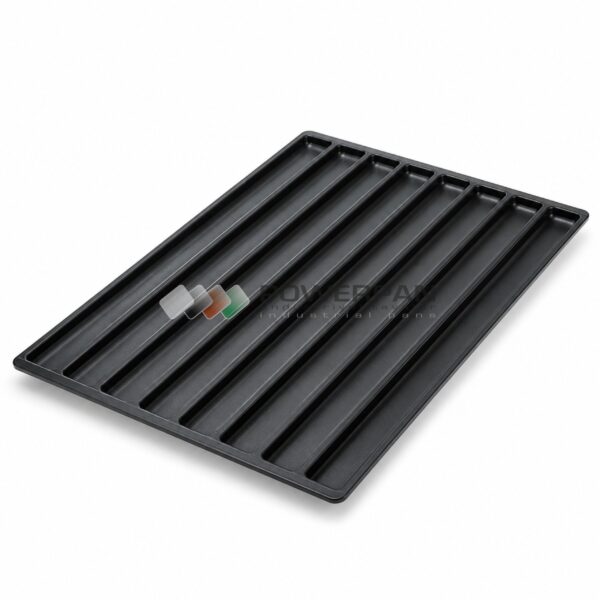
A grissini tray is assessed for production in which many thin breadsticks are placed on the same carrier. In series production, shaping, dough transfer, and baked product removal are as important as tray area. The name pan or tray does not inherently define a particular daily production capacity.
Select surface area together with line dimensions
When choosing a large tray, check conveyor width, oven entry, and empty-tray return. Placing more products in the inner area requires maintaining spacing between them. Thin breadsticks touching one another or their ends pressing against the edge can change appearance and removal.
If a channeled structure is being considered, assess the shaping machine’s output together with channel centers. On a flat surface, examine dough position after transfer and possible sliding. For both approaches, observe handling and line passage with the tray loaded during the sample trial.
Calculate actual capacity from the process
The number of products fitting on one tray is only part of the daily production calculation. Monitor baking, cooling, product removal, and cleaning times together with tray circulation. Converting an increase in tray area directly into an efficiency percentage can overlook constraints at these stages.
- Define dough strip length and target cross section.
- Share the dimensions of transfer and product removal equipment.
- Specify tray outer dimensions and edge profile.
- Record layout, end baking, and breakage in the sample trial.
- Check the empty-tray return and stacking arrangement.
Coating and monitoring in series use
Match the coating system to the recipe and removal method. Uninterrupted line operation or longer durability of a particular coating cannot be inferred from a general product description. Trial records can track surface release and cleaning requirements together.
Regularly inspect tray flatness, edge contact, and coating damage. Mark and separate problem trays; do not scrape coated surfaces with metal tools. Providing the line drawing, product dimensions, and production flow in a request to Powerpan clarifies how the large surface will actually be used at the facility.