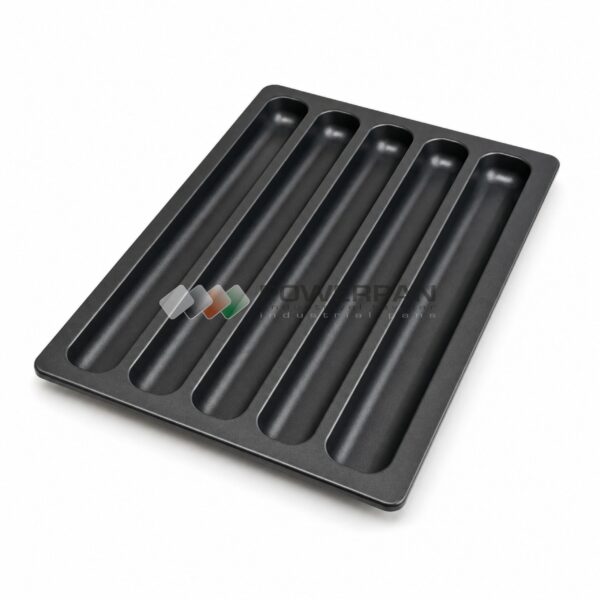
A grissini pan is used to manage the shape and tray layout of thin breadsticks. Channeled and flat surfaces are assessed for different layouts. Suitability depends on the product’s cross section and shaping arrangement; a dedicated channeled mold is not required for every grissini production process.
The difference between channels and free placement
A channel defines the dough strip’s position and limits sideways movement. Match the target thickness to the channel cross section. If the dough overfills the channel during proofing, product shape and removal behavior may change. Do not assume that a narrow or deep channel is better for every thin product.
On a flat surface, shaping and product spacing depend more directly on the facility’s placement arrangement. This approach can be assessed for production targeting a handmade appearance. Check contact between pieces and ends pressing against the pan edge in the sample trial.
Baking and transferring thin ends
A grissini breadstick’s middle and ends may not have the same thickness. Rather than looking only at overall color, examine these areas separately during the trial. Assess breakage during transfer to the cooling area together with surface release and the movement of tools used.
- Define target breadstick length and cross section.
- Specify the manual or machine shaping method.
- Share how seeds and spices are applied.
- Record end color, release, and breakage during handling in the sample trial.
- Check product spacing again after proofing.
Cleaning and technical requests
Seeds or dried dough pieces can collect at channel ends. Use a brush suitable for the surface; do not scrape narrow areas with metal tips. When selecting a coating, consider dough ingredients, operating conditions, and the cleaning method together. A goal of removal without breakage is not a promise of zero rejects.
A request to Powerpan can explain product shape and the placement method before production volume. Do not treat the pan as mandatory or unnecessary based on specific quantity thresholds. Clarifying outer dimensions, channel section if present, and the surface system in the quote allows sample assessment against clearer criteria.