
Food-grade non-stick coatings and document scope
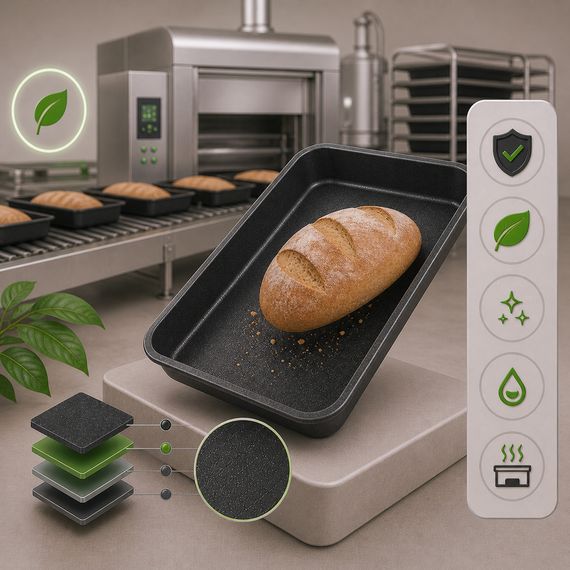
Food-grade non-stick coatings involve two distinct expectations: that the surface is suitable for specified food contact conditions and that it helps the product release from the surface. Neither property proves the other. Dough releasing easily does not show that the coating is suitable for every food or temperature.
What food-grade means
Food contact assessment must be tied to the finished coating formulation and its conditions of use. Contact time, temperature, and food type must be stated explicitly. The FDA also considers identity, specifications, and use limitations together when assessing component compliance. The FDA guidance on component assessment explains why this scope matters.
A food-grade label alone is not a test report or compliance file. Check which product, sample, and conditions the document covers. Management system certification does not replace the product’s food contact assessment either. It is not accurate to distinguish household and industrial products through generalizations based only on documentation or layer count.
Test non-stick performance separately
Bread dough, cakes containing eggs, and sugary products can behave differently during release. Trials must use the actual recipe, recording product left in the mold and damage during removal. An initially successful trial does not prove that the surface will maintain the same performance throughout its service life.
- Record the product recipe and baking program.
- Define pan geometry and the removal method.
- Monitor residue and surface condition after cleaning.
- Match coating identity to usage records.
Application records and maintenance
When submitting a coating request to Powerpan, share the metal body material, dimensions, operating conditions, and cleaning method. Technical limits, inspection scope, and the food contact file can be requested as separate sections in the quote. Do not assign a fixed temperature or cycle life to every system.
Recoating does not turn a damaged metal body into new equipment. Bending, cracks, and corrosion require a separate assessment. Surfaces with peeling or blistering must be taken out of service for inspection. Cleanability does not mean that sanitation can be eliminated. When product suitability, surface integrity, and actual production performance are monitored together, food-grade non-stick becomes more than an ambiguous label.
Release trials on a multi-cavity mold must cover different cavities. Results from a single, easily accessible surface must not be generalized to the entire geometry. Record behavior at the edges and base separately. Similarly, when comparing appearance after cleaning across different product groups, state the method used. These records must maintain the distinction between food contact assessment and non-stick performance assessment.