
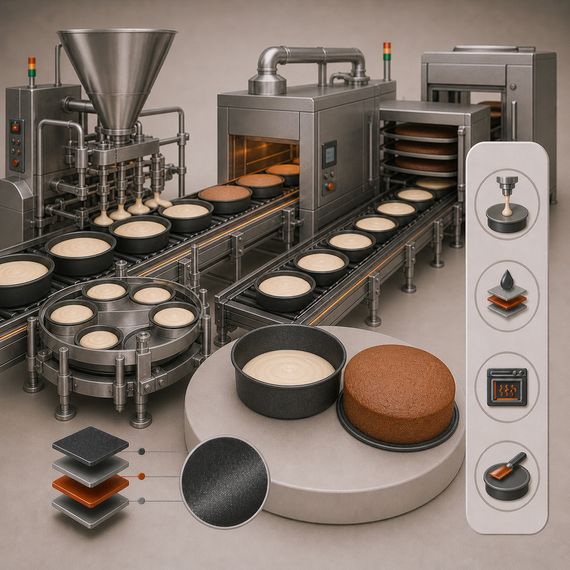

Cake and pastry production uses moulds and trays whose surface detail is often visible in the finished product. Sticking at a corner, cavity or patterned face can damage the product during release. Selecting a coating starts with the mixture, mould geometry and production method.
Understand where release becomes difficult
Sugar, fat and egg content can change how a mixture behaves against a baking surface. Cooling and demoulding practices also matter. Record where sticking occurs and whether it affects all cavities, particular shapes or only certain recipes. This is more informative than treating every release problem as general coating failure.
Match the system to the mould
Flat trays, deep cake moulds and detailed forms present different surfaces for preparation and application. The condition of edges and recesses needs inspection before coating renewal is proposed. A non-stick system should be selected for the equipment material and intended conditions, with food-contact documentation relevant to that use.
- Provide the mould or tray dimensions and cavity layout.
- Describe the mixture and the baking, cooling and release sequence.
- Identify existing damage, deposits and cleaning methods.
- Explain the product appearance or handling issue to be addressed.
Review care and renewal together
Cleaning tools, stacking contact and demoulding methods can affect the surface between baking cycles. Follow the care requirements for the selected system. If the coating has worn, assess the mould body before deciding on recoating. Surface renewal cannot be assumed to repair cracks, distortion or loss of the original mould detail.