
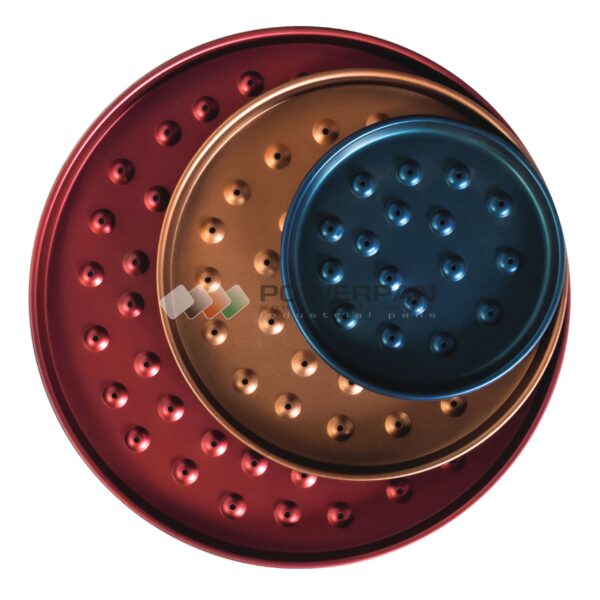
A round baking tray must fit the oven’s support and handling arrangement as well as the product. Its shape does not automatically make it compatible with rotary, convection, or tunnel systems.
Check the equipment interface
Provide outside diameter, depth, rim profile, and support details. Identify the rack or conveying arrangement and relevant clearances. Where rotation or automated movement is involved, assess the actual equipment requirements rather than relying on a general round-tray description.
Describe the baking task
Identify the product, load, and operating cycle. Solid and perforated bases need consideration for the intended use. A coating’s operating suitability must be checked for the complete system, not assumed from a material-family name.
- Provide a tray drawing and oven reference.
- Describe loading, cooling, and release.
- Identify cleaning and stacking practices.
- State relevant food-contact documentation needs.
For existing trays, inspect flatness and support damage alongside surface condition. Uneven baking may involve the oven, loading, or pan body as well as the coating. Confirm the proposed design before treating nominally similar round trays as interchangeable across different equipment.