
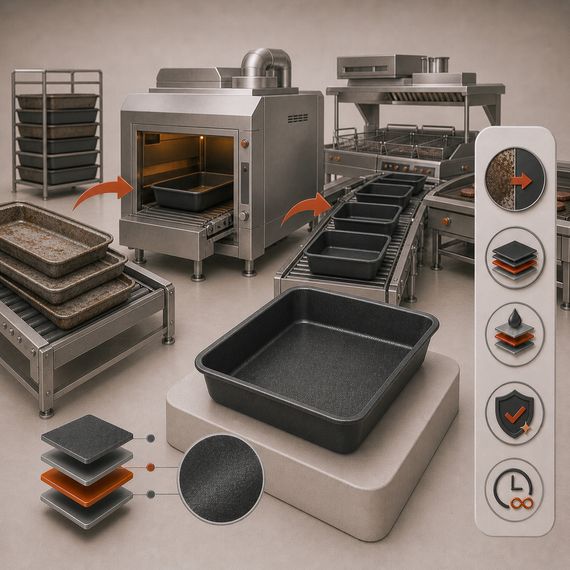
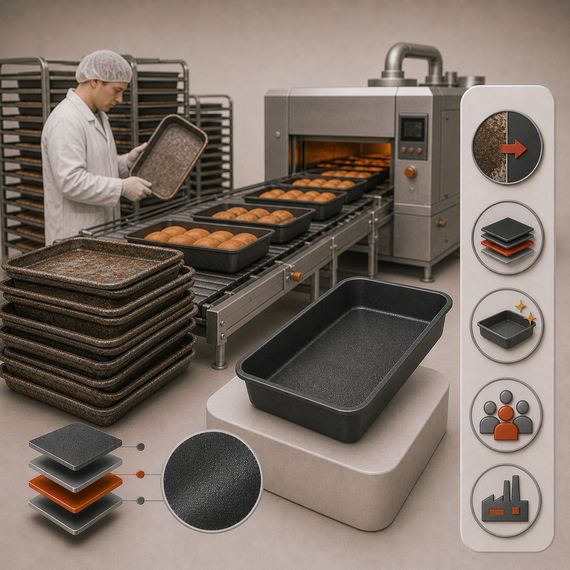
Second-hand baking trays need assessment before they are added to a working inventory. Their dimensions, condition, and history matter independently of the price or appearance of the coating.
Check what can be established
Identify the material and design where possible. Compare outer dimensions, support edges, and cavity layout with the equipment in which the trays will be used. Unknown coating identity or maintenance history should be recorded as missing information, not filled in by assumption.
- Inspect distortion, corrosion, joints, and damaged rims.
- Check for peeling, exposed substrate, and persistent deposits.
- Separate matching trays from mixed or modified designs.
- Review the evidence needed for the intended food-contact use.
Assess renewal before committing to reuse
A suitable body may be considered for coating removal, preparation, and recoating. A fresh surface does not prove that the underlying equipment is sound or that it fits the production line. Some items may need replacement rather than renewal.
For an inquiry, provide photographs, quantities, and the operating conditions planned for the trays. Compare the complete renewal scope with alternative equipment rather than assuming that second-hand purchase plus recoating is always the less costly option.