
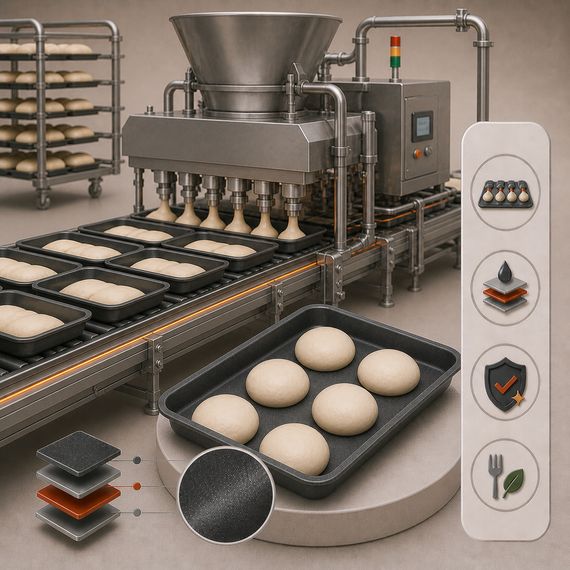
Sandwich and hamburger bread lines depend on pan geometry and handling compatibility as well as surface release. Round burger buns and elongated sandwich breads need different cavity profiles, even when their trays share an outer footprint.
Define the bread and cavity layout
Specify the target shape, dough weight, cavity depth, and spacing. Proofing and baking affect the finished dimensions, so a cavity measurement is not a guaranteed bun size. Include the loading pattern and how the bread is removed after baking.
Consider the tray’s route
Rims, reinforcement, and support points can determine whether a tray works with conveyors and automatic handling. Compare a proposed design with the actual equipment rather than assuming that a familiar size label establishes compatibility.
- Provide a drawing and reference product.
- Describe proofing, baking, cooling, and release.
- Identify cleaning and stacking practices.
- Explain any recurring sticking or contact damage.
Select the coating for the substrate and production conditions, with food-contact documentation relevant to that use. A surface treatment cannot compensate for the wrong cavity layout or a distorted tray. Replacement and recoating inquiries should therefore include the condition of the whole pan.