
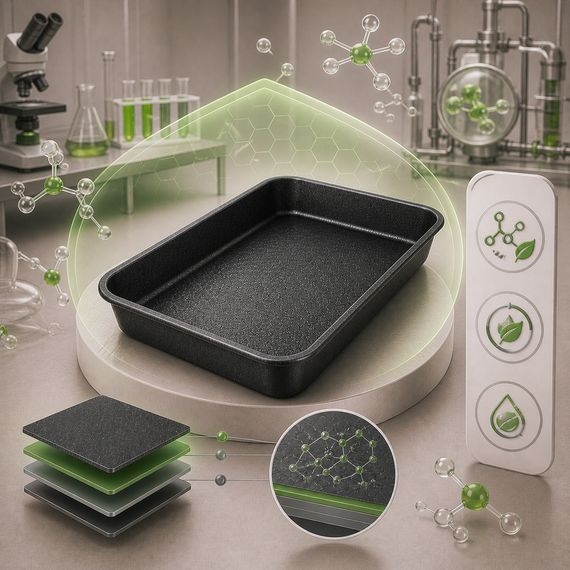

Claims that a coating is free of harmful substances need a precise meaning. The substance, coating formulation, test or declaration and intended use must be identified. A broad expression such as “non-toxic” cannot answer every question about a material under all conditions.
Use chemical names accurately
PTFE means polytetrafluoroethylene. PFOA is a different chemical, not another name for PTFE. A statement about the absence of PFOA should not be expanded into a claim that a coating contains no fluoropolymers or is free of every substance covered by a broader chemical grouping.
Ask what supports the statement
Supplier declarations and relevant test reports need to identify the material they concern. Read the wording and any limits or conditions rather than converting a specific statement into an absolute guarantee. A claim about a raw material does not automatically describe every component of a finished coating system.
- Identify the exact coating or formulation.
- Name the substance or group being assessed.
- Check the basis and scope of the declaration or testing.
- Confirm whether the evidence relates to the intended application.
Food-contact suitability is a separate assessment
The absence of one named substance does not establish that a coating is suitable for every food-contact use. Processing conditions, cleaning and the complete system still matter. Request application-specific documentation and clarification of any purchasing restriction before selecting a surface. Avoid treating an ISO certificate or a general environmental statement as a substitute for that evidence.