
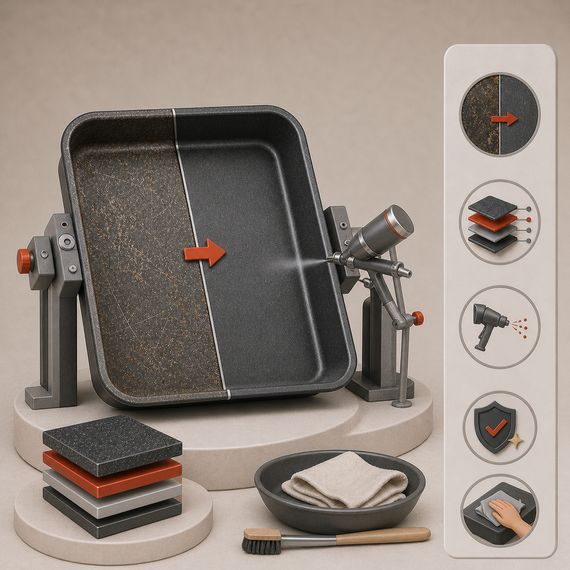
Coating removal prepares a worn coated surface for assessment and possible recoating. It is different from routine washing: the work concerns the existing coating and firmly attached deposits, not just removable food residue. The removal method must suit the equipment’s base material, construction and condition.
When removal needs assessment
Peeling, persistent sticking, exposed metal or deposits that remain after the prescribed cleaning routine are reasons to inspect a pan or mould. They do not establish that aggressive stripping is appropriate. Photographs and the history of the equipment help distinguish coating wear from damage to the body.
Protect the underlying equipment
Cleaning, abrasive preparation and other stripping processes place different demands on a component. Thin sections, welded joints and detailed mould surfaces need particular attention. The chosen process should remove the unwanted layer while preserving the geometry needed for the next stage.
- Identify the metal and any existing coating information.
- Record distortion, corrosion, cracks and damaged edges before treatment.
- Agree which areas are to be prepared and which must be protected.
- Inspect the stripped surface before deciding whether recoating can proceed.
Removal is one stage of renewal
A clean-looking surface is not, on its own, evidence that the equipment is ready for a new coating. Surface condition, remaining contamination and structural suitability still need evaluation. Avoid experimenting with unapproved chemicals or abrasive tools on production equipment. For an assessment, provide the equipment dimensions, operating conditions and the problem that prompted the request.