
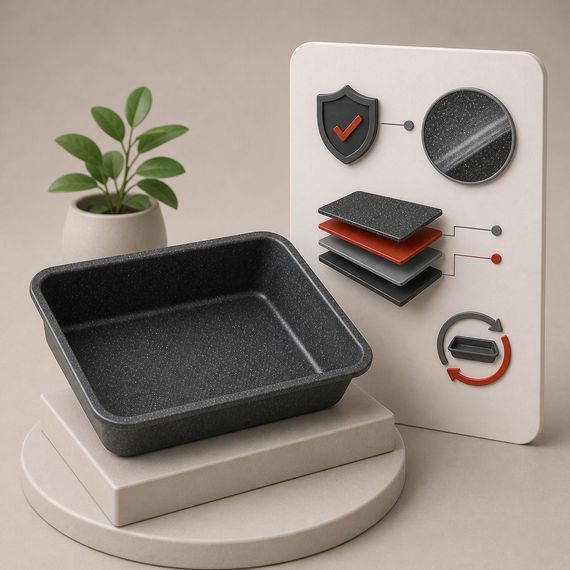
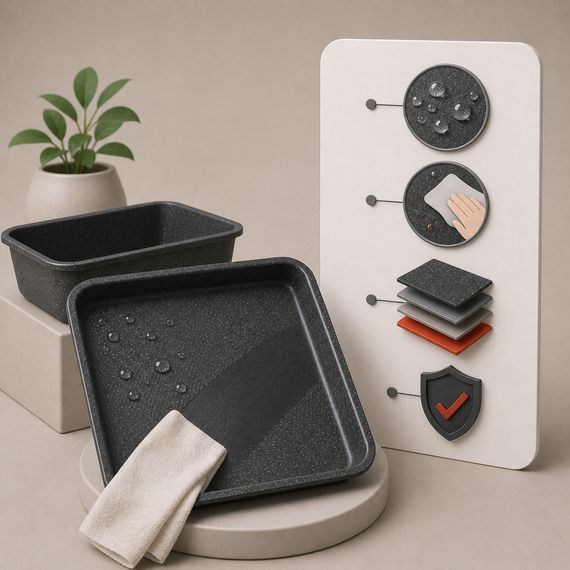
Mass-production pans need to fit a production line repeatedly, not simply hold the right amount of dough. Overall dimensions, cavity layout, rim profile and stacking behaviour all affect how a pan moves through loading, baking, release and cleaning. This category covers pan selection for repeat production and the practical requirements behind a consistent pan inventory.
Specify the pan around the line
Begin with the finished product and the equipment that handles the pan. A tray that fits inside an oven may still be unsuitable for its conveyor guides, loading equipment or stacking system. Drawings should distinguish external dimensions from usable baking space and identify the surfaces used for support or handling.
- Product shape, dough weight and intended cavity arrangement.
- Pan dimensions, depth, material and reinforcement details.
- Clearances at conveyors, racks, oven supports and transfer points.
- Release method, cleaning routine and coating requirements.
Consistency across replacement batches
An approved drawing or reference sample gives replacement orders a common basis. Record changes to the design so that older and newer pans are not treated as interchangeable without checking them. Where automation is involved, assess a representative pan on the actual handling system before committing to a wider replacement.
Plan for use and renewal
Inspect the pan body as well as its coating. Distortion, damaged edges and loose connections can affect handling even when the baking surface looks acceptable. Recoating may be worth assessing when the body remains suitable; it does not correct structural damage by itself. Quantities, production scheduling and delivery arrangements need a project-specific quotation.